


Page 286 - Physical chemistry understanding our chemical world
P. 286
‘STRONG’ AND ‘WEAK’ ACIDS AND BASES    253

                                                     −
                                           +
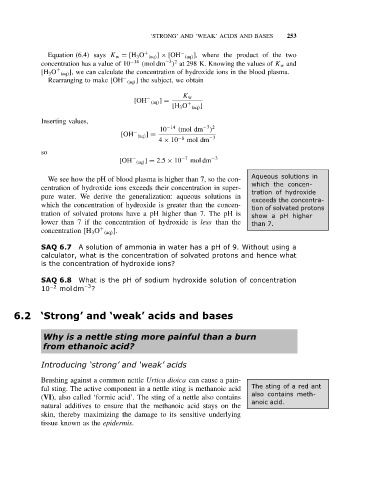
               Equation (6.4) says K w = [H 3 O (aq) ] × [OH (aq) ], where the product of the two
                                                 −3 2
             concentration has a value of 10 −14  (mol dm ) at 298 K. Knowing the values of K w and
                 +
             [H 3 O (aq) ], we can calculate the concentration of hydroxide ions in the blood plasma.
               Rearranging to make [OH (aq) ] the subject, we obtain
                                     −
                                                      K w
                                            −
                                        [OH (aq) ] =
                                                       +
                                                   [H 3 O (aq) ]
             Inserting values,
                                                            −3 2
                                               10 −14  (mol dm )
                                        −
                                    [OH (aq) ] =              −3
                                               4 × 10 −8  mol dm
             so
                                       −
                                    [OH (aq) ] = 2.5 × 10 −7  mol dm −3
                                                                          Aqueous solutions in
               We see how the pH of blood plasma is higher than 7, so the con-
             centration of hydroxide ions exceeds their concentration in super-  which the concen-
                                                                          tration of hydroxide
             pure water. We derive the generalization: aqueous solutions in
                                                                          exceeds the concentra-
             which the concentration of hydroxide is greater than the concen-
                                                                          tion of solvated protons
             tration of solvated protons have a pH higher than 7. The pH is  show a pH higher
             lower than 7 if the concentration of hydroxide is less than the  than 7.
                              +
             concentration [H 3 O (aq) ].
             SAQ 6.7 A solution of ammonia in water has a pH of 9. Without using a
             calculator, what is the concentration of solvated protons and hence what
             is the concentration of hydroxide ions?

             SAQ 6.8 What is the pH of sodium hydroxide solution of concentration
             10 −2  mol dm −3 ?


     6.2     ‘Strong’ and ‘weak’ acids and bases


              Why is a nettle sting more painful than a burn
              from ethanoic acid?

             Introducing ‘strong’ and ‘weak’ acids

             Brushing against a common nettle Urtica dioica can cause a pain-
             ful sting. The active component in a nettle sting is methanoic acid  The sting of a red ant
                                                                          also contains meth-
             (VI), also called ‘formic acid’. The sting of a nettle also contains
                                                                          anoic acid.
             natural additives to ensure that the methanoic acid stays on the
             skin, thereby maximizing the damage to its sensitive underlying
             tissue known as the epidermis.

