


Page 289 - Physical chemistry understanding our chemical world
P. 289
256    ACIDS AND BASES

                                                                                              −5
                        The value of K a for ethanoic acid is a hundred thousand times larger at 1.8 × 10 ,
                                                                             −4
                      and K a for methanoic acid is ten times larger still, at 1.8 × 10 ; so methanoic acid
                      generates more solvated protons per mole of acid than either phenol or ethanoic acid.
                        We discover the relative differences in K a when walking in the country, for a nettle
                      can give a nasty sting (i.e. a chemical burn) but vinegar does not burn the skin. We
                      say methanoic acid is a stronger acid than ethanoic acid because its value of K a is
                      larger. A mole of phenol yields few protons, so we say it is a weak acid, because its
                      value of K a is tiny.
                                        These descriptions of ‘strong’ and ‘weak’ acid are no longer
              A strong acid has a     subjective, but depend on the magnitude of K a :a strong acid has
              large value of K a ,and
                                      a large value of K a and a weak acid has a low value of K a . Stated
              a weak acid has a low
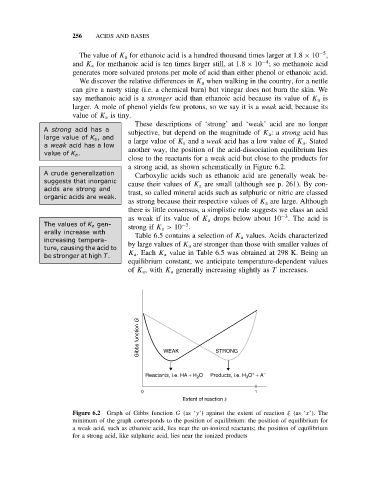
              value of K a .          another way, the position of the acid-dissociation equilibrium lies
                                      close to the reactants for a weak acid but close to the products for
                                      a strong acid, as shown schematically in Figure 6.2.
              A crude generalization    Carboxylic acids such as ethanoic acid are generally weak be-
              suggests that inorganic  cause their values of K a are small (although see p. 261). By con-
              acids are strong and    trast, so called mineral acids such as sulphuric or nitric are classed
              organic acids are weak.
                                      as strong because their respective values of K a are large. Although
                                      there is little consensus, a simplistic rule suggests we class an acid
                                                                                   −3
                                      as weak if its value of K a drops below about 10 . The acid is
              The values of K a gen-  strong if K a > 10 .
                                                      −3
              erally increase with      Table 6.5 contains a selection of K a values. Acids characterized
              increasing tempera-     by large values of K a are stronger than those with smaller values of
              ture, causing the acid to
              be stronger at high T.  K a . Each K a value in Table 6.5 was obtained at 298 K. Being an
                                      equilibrium constant, we anticipate temperature-dependent values
                                      of K a , with K a generally increasing slightly as T increases.


                                         Gibbs function G  WEAK  STRONG


                                                                          +
                                           Reactants, i.e. HA + H 2 O  Products, i.e. H 3 O + A −

                                          0                                1
                                                      Extent of reaction x
                      Figure 6.2 Graph of Gibbs function G (as ‘y’) against the extent of reaction ξ (as ‘x’). The
                      minimum of the graph corresponds to the position of equilibrium: the position of equilibrium for
                      a weak acid, such as ethanoic acid, lies near the un-ionized reactants; the position of equilibrium
                      for a strong acid, like sulphuric acid, lies near the ionized products

