


Page 290 - Physical chemistry understanding our chemical world
P. 290
‘STRONG’ AND ‘WEAK’ ACIDS AND BASES    257

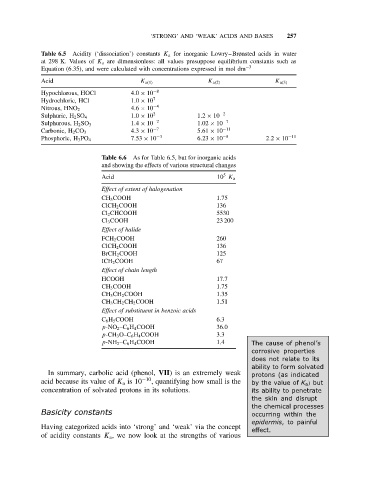
             Table 6.5 Acidity (‘dissociation’) constants K a for inorganic Lowry–Brønsted acids in water
             at 298 K. Values of K a are dimensionless: all values presuppose equilibrium constants such as
             Equation (6.35), and were calculated with concentrations expressed in mol dm −3
             Acid                         K a(1)             K a(2)              K a(3)
             Hypochlorous, HOCl        4.0 × 10 −8
             Hydrochloric, HCl         1.0 × 10 7
                                       4.6 × 10 −4
             Nitrous, HNO 2
                                       1.0 × 10 2         1.2 × 10 −2
             Sulphuric, H 2 SO 4
                                       1.4 × 10 −2        1.02 × 10 −7
             Sulphurous, H 2 SO 3
                                       4.3 × 10 −7        5.61 × 10 −11
             Carbonic, H 2 CO 3
             Phosphoric, H 3 PO 4      7.53 × 10 −3       6.23 × 10 −8        2.2 × 10 −11
                               Table 6.6  As for Table 6.5, but for inorganic acids
                               and showing the effects of various structural changes
                                                                  5
                               Acid                             10 K a
                               Effect of extent of halogenation
                               CH 3 COOH                        1.75
                               ClCH 2 COOH                      136
                               Cl 2 CHCOOH                      5530
                               Cl 3 COOH                        23 200
                               Effect of halide
                               FCH 2 COOH                       260
                               ClCH 2 COOH                      136
                               BrCH 2 COOH                      125
                               ICH 2 COOH                       67
                               Effect of chain length
                               HCOOH                            17.7
                               CH 3 COOH                        1.75
                               CH 3 CH 2 COOH                   1.35
                               CH 3 CH 2 CH 2 COOH              1.51
                               Effect of substituent in benzoic acids
                               C 6 H 5 COOH                     6.3
                               p-NO 2 –C 6 H 4 COOH             36.0
                               p-CH 3 O–C 6 H 4 COOH            3.3
                               p-NH 2 –C 6 H 4 COOH             1.4       The cause of phenol’s
                                                                          corrosive properties
                                                                          does not relate to its
                                                                          ability to form solvated
               In summary, carbolic acid (phenol, VII) is an extremely weak  protons (as indicated
             acid because its value of K a is 10 −10 , quantifying how small is the  by the value of K a ) but
             concentration of solvated protons in its solutions.          its ability to penetrate
                                                                          the skin and disrupt
                                                                          the chemical processes
             Basicity constants                                           occurring within the
                                                                          epidermis, to painful
             Having categorized acids into ‘strong’ and ‘weak’ via the concept
                                                                          effect.
             of acidity constants K a , we now look at the strengths of various

