


Page 91 - Physical chemistry eng
P. 91
68     CHAPTER 4 Thermochemistry

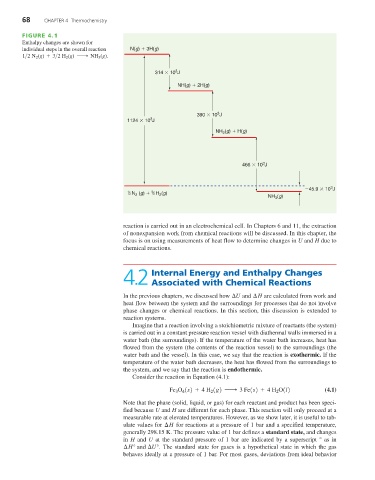
        FIGURE 4.1
        Enthalpy changes are shown for
        individual steps in the overall reaction   N(g)   3H(g)
        1>2  N 2 (g) + 3>2  H 2 (g) ¡  NH 3 (g).

                                                          3
                                                    314   10 J
                                                           NH(g)   2H(g)


                                                                        3
                                                                 390   10 J
                                                  3
                                          1124   10 J
                                                                          (g)   H(g)
                                                                       NH 2


                                                                                       3
                                                                                466   10 J


                                                                                                             3
                                                                                                     45.9   10 J
                                           1 2 N  (g)    3 2 H (g)
                                                     2
                                             2
                                                                                        NH 3 (g)

                                         reaction is carried out in an electrochemical cell. In Chapters 6 and 11, the extraction
                                         of nonexpansion work from chemical reactions will be discussed. In this chapter, the
                                         focus is on using measurements of heat flow to determine changes in U and H due to
                                         chemical reactions.


                                                  Internal Energy and Enthalpy Changes
                                         4.2 Associated with Chemical Reactions

                                         In the previous chapters, we discussed how ¢U  and ¢H  are calculated from work and
                                         heat flow between the system and the surroundings for processes that do not involve
                                         phase changes or chemical reactions. In this section, this discussion is extended to
                                         reaction systems.
                                            Imagine that a reaction involving a stoichiometric mixture of reactants (the system)
                                         is carried out in a constant pressure reaction vessel with diathermal walls immersed in a
                                         water bath (the surroundings). If the temperature of the water bath increases, heat has
                                         flowed from the system (the contents of the reaction vessel) to the surroundings (the
                                         water bath and the vessel). In this case, we say that the reaction is exothermic. If the
                                         temperature of the water bath decreases, the heat has flowed from the surroundings to
                                         the system, and we say that the reaction is endothermic.
                                            Consider the reaction in Equation (4.1):

                                                        Fe O (s) + 4 H (g) ¡ 3 Fe(s) + 4 H O(l)            (4.1)
                                                                      2
                                                                                           2
                                                          3 4
                                         Note that the phase (solid, liquid, or gas) for each reactant and product has been speci-
                                         fied because U and H are different for each phase. This reaction will only proceed at a
                                         measurable rate at elevated temperatures. However, as we show later, it is useful to tab-
                                         ulate values for  ¢H  for reactions at a pressure of 1 bar and a specified temperature,
                                         generally 298.15 K. The pressure value of 1 bar defines a standard state, and changes
                                         in H and U at the standard pressure of 1 bar are indicated by a superscript ° as in
                                         ¢H° and ¢U° . The standard state for gases is a hypothetical state in which the gas
                                         behaves ideally at a pressure of 1 bar. For most gases, deviations from ideal behavior

