


Page 94 - Physical chemistry eng
P. 94
4.3 HESS’S LAW IS BASED ON ENTHALPY BEING A STATE FUNCTION  71

              Setting H° m = 0 for each element in its standard reference state,

                     ¢H°(Fe O ,s) = H° (Fe O ,s) - 3 * 0 - 2 * 0 = H° (Fe O ,s)  (4.9)
                                                                       3 4
                                                                   m
                                         3 4
                        f
                            3 4
                                      m
              The value of ¢H° R  for any reaction involving compounds and elements is unchanged by
              this convention. In fact, one could choose a different number for the absolute enthalpy
              of each pure element in its standard reference state, and it would still not change the
              value of ¢H° R . However, it is much more convenient (and easier to remember) if one
              sets H° m  = 0 for all elements in their standard reference state. This convention will be
              used again in Chapter 6 when the chemical potential is discussed.

                       Hess’s Law Is Based on Enthalpy Being
              4.3 a State Function

              As discussed in the previous section, it is extremely useful to have tabulated values of
              ¢H° f  for chemical compounds at one fixed combination of P and T. Tables 4.1 and 4.2
              list this data for 1 bar and 298.15 K. With access to these values of ¢H° f , ¢H° R  can be
              calculated for all reactions among these elements and compounds at 1 bar and 298.15 K.
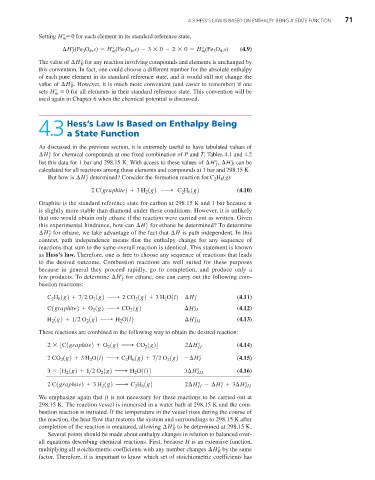
                 But how is ¢H° f  determined? Consider the formation reaction for C H (g):
                                                                       2 6
                               2 C(graphite) + 3 H (g)  ¡  C H (g)            (4.10)
                                                2
                                                            2 6
              Graphite is the standard reference state for carbon at 298.15 K and 1 bar because it
              is slightly more stable than diamond under these conditions. However, it is unlikely
              that one would obtain only ethane if the reaction were carried out as written. Given
              this experimental hindrance, how can ¢H° f  for ethane be determined? To determine
              ¢H° f  for ethane, we take advantage of the fact that ¢H  is path independent. In this
              context, path independence means that the enthalpy change for any sequence of
              reactions that sum to the same overall reaction is identical. This statement is known
              as Hess’s law. Therefore, one is free to choose any sequence of reactions that leads
              to the desired outcome. Combustion reactions are well suited for these purposes
              because in general they proceed rapidly, go to completion, and produce only a
              few products. To determine ¢H° f  for ethane, one can carry out the following com-
              bustion reactions:

                  C H (g) + 7>2 O (g) ¡ 2 CO (g) + 3 H O(l)    ¢H° I          (4.11)

                                             2
                                                       2
                               2
                  2 6
                  C(graphite) + O (g) ¡ CO (g)                ¢H° II          (4.12)
                                           2
                               2
                  H (g) + 1>2 O (g) ¡ H O(l)                 ¢H° III          (4.13)
                  2
                             2
                                        2
              These reactions are combined in the following way to obtain the desired reaction:
                 2 * [C(graphite) + O (g) ¡ CO (g)]       2¢H°    II          (4.14)
                                    2
                                                2
                 2 CO (g) + 3 H O(l) ¡ C H (g) + 7>2 O (g)  -¢H°  I           (4.15)
                     2
                                          2 6
                              2
                                                        2
                 3 * [H (g) + 1>2 O (g) ¡ H O(l)]        3¢H°    III          (4.16)
                                             2
                                  2
                       2
                 2 C(graphite) + 3 H (g) ¡ C H (g)       2¢H° -¢H° + 3¢H°        III
                                                                  II
                                             2 6
                                  2
                                                                         I
              We emphasize again that it is not necessary for these reactions to be carried out at
              298.15 K. The reaction vessel is immersed in a water bath at 298.15 K and the com-
              bustion reaction is initiated. If the temperature in the vessel rises during the course of
              the reaction, the heat flow that restores the system and surroundings to 298.15 K after
              completion of the reaction is measured, allowing ¢H° R  to be determined at 298.15 K.
                 Several points should be made about enthalpy changes in relation to balanced over-
              all equations describing chemical reactions. First, because H is an extensive function,
              multiplying all stoichiometric coefficients with any number changes ¢H° R  by the same
              factor. Therefore, it is important to know which set of stoichiometric coefficients has

