


Page 98 - Physical chemistry eng
P. 98
¢
                                                 4.5 THE EXPERIMENTAL DETERMINATION OF  U AND ¢ H FOR CHEMICAL REACTIONS  75
              In this particular case, the change in the reaction enthalpy with T is not large. This is
              the case because ¢C (T)  is small and not because an individual C (T)  is small.
                              P
                                                                   P,i

                       The Experimental Determination of
              4.5 ¢      U and ¢    H for Chemical Reactions


              For chemical reactions, ¢U  and ¢H  are generally determined through experiment. In this
              section, we discuss how these experiments are carried out. If some or all of the reactants or  Thermometer
              products are volatile, it is necessary to contain the reaction mixture for which ¢U  and ¢H  Stirrer
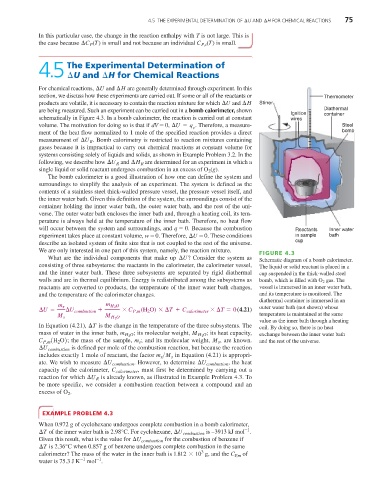
              are being measured. Such an experiment can be carried out in a bomb calorimeter, shown       Diathermal
                                                                                                Ignition   container
              schematically in Figure 4.3. In a bomb calorimeter, the reaction is carried out at constant  wires
              volume. The motivation for doing so is that if dV = 0, ¢U = q  . Therefore, a measure-             Steel
                                                                V                                                bomb
              ment of the heat flow normalized to 1 mole of the specified reaction provides a direct
              measurement of  ¢U R . Bomb calorimetry is restricted to reaction mixtures containing
              gases because it is impractical to carry out chemical reactions at constant volume for
              systems consisting solely of liquids and solids, as shown in Example Problem 3.2. In the
              following, we describe how ¢U R  and ¢H R  are determined for an experiment in which a
              single liquid or solid reactant undergoes combustion in an excess of O (g).
                                                                     2
                 The bomb calorimeter is a good illustration of how one can define the system and
              surroundings to simplify the analysis of an experiment. The system is defined as the
              contents of a stainless steel thick-walled pressure vessel, the pressure vessel itself, and
              the inner water bath. Given this definition of the system, the surroundings consist of the
              container holding the inner water bath, the outer water bath, and the rest of the uni-
              verse. The outer water bath encloses the inner bath and, through a heating coil, its tem-
              perature is always held at the temperature of the inner bath. Therefore, no heat flow
              will occur between the system and surroundings, and q = 0. Because the combustion  Reactants  Inner water
              experiment takes place at constant volume, w = 0. Therefore, ¢U  = 0. These conditions  in sample  bath
              describe an isolated system of finite size that is not coupled to the rest of the universe.  cup
              We are only interested in one part of this system, namely, the reaction mixture.
                                                                                      FIGURE 4.3
                 What are the individual components that make up  ¢U ? Consider the system as  Schematic diagram of a bomb calorimeter.
              consisting of three subsystems: the reactants in the calorimeter, the calorimeter vessel,  The liquid or solid reactant is placed in a
              and the inner water bath. These three subsystems are separated by rigid diathermal  cup suspended in the thick-walled steel
              walls and are in thermal equilibrium. Energy is redistributed among the subsystems as  bomb, which is filled with O 2 gas. The
              reactants are converted to products, the temperature of the inner water bath changes,  vessel is immersed in an inner water bath,
              and the temperature of the calorimeter changes.                         and its temperature is monitored. The
                                                                                      diathermal container is immersed in an
                    m s            m H 2 O
              ¢U =    ¢U combustion  +   * C P,m (H O) *¢T + C calorimeter  *¢T = 0 (4.21)  outer water bath (not shown) whose
                                                 2
                    M s            M H 2 O                                            temperature is maintained at the same
                                                                                      value as the inner bath through a heating
              In Equation (4.21), ¢T  is the change in the temperature of the three subsystems. The  coil. By doing so, there is no heat
              mass of water in the inner bath, m H 2 O ; its molecular weight, M H 2 O ; its heat capacity,  exchange between the inner water bath
              C P,m (H O) ; the mass of the sample, m s ; and its molecular weight, M s , are known.  and the rest of the universe.
                    2
              ¢U combustion  is defined per mole of the combustion reaction, but because the reaction
              includes exactly 1 mole of reactant, the factor m >M s  in Equation (4.21) is appropri-
                                                     s
              ate. We wish to measure ¢U combustion . However, to determine ¢U combustion , the heat
              capacity of the calorimeter, C calorimeter , must first be determined by carrying out a
              reaction for which ¢U R  is already known, as illustrated in Example Problem 4.3. To
              be more specific, we consider a combustion reaction between a compound and an
              excess of O .
                       2

               EXAMPLE PROBLEM 4.3
              When 0.972 g of cyclohexane undergoes complete combustion in a bomb calorimeter,
                                                                                 -1
              ¢T  of the inner water bath is 2.98°C. For cyclohexane, ¢U combustion  is –3913 kJ mol .
              Given this result, what is the value for ¢U combustion  for the combustion of benzene if
              ¢T  is 2.36°C when 0.857 g of benzene undergoes complete combustion in the same
                                                                   3
              calorimeter? The mass of the water in the inner bath is 1.812 * 10  g,  and the C P,m  of
                           -1   -1
              water is 75.3 J K  mol .

