


Page 93 - Physical chemistry eng
P. 93
70 CHAPTER 4 Thermochemistry
3 Fe(s) + 2 O (g) ¡ Fe O (s)
3 4
2
¢H° =¢H°(Fe O , s) = H° (Fe O , s) - 3H° (Fe, s) - 2H° (O , g) (4.4)
m
3 4
m
2
f
m
R
3 4
If Equation (4.2) is rewritten in terms of the enthalpies of formation, a simple equation
for the reaction enthalpy is obtained:
¢H° = 4¢H°(H O, l) -¢H°(Fe O , s) (4.5)
3 4
R
f
2
f
Note that elements in their standard reference state do not appear in this equation because
¢H° = 0 for these species. This result can be generalized to any chemical transformation
f
n A + n B + . . . ¡ n X + n Y + . . . (4.6)
X
B
Y
A
which we write in the form
0 = n X (4.7)
a i i
i
The X refer to all species that appear in the overall equation. The unitless stoichiometric
i
coefficients v are positive for products and negative for reactants. The enthalpy change
i
associated with this reaction is
¢H° = n ¢H° f,i (4.8)
a i
R
i
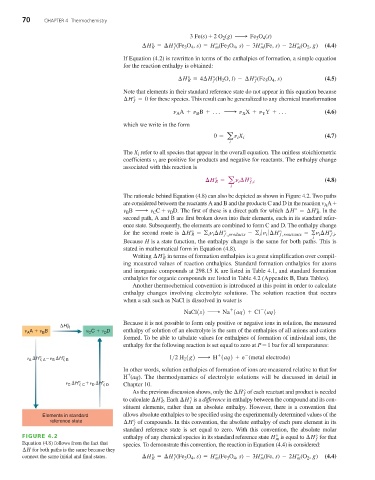
The rationale behind Equation (4.8) can also be depicted as shown in Figure 4.2. Two paths
are considered between the reactants A and B and the products C and D in the reaction v A +
A
v B ¡ v C + v D. The first of these is a direct path for which ¢H° =¢H° R . In the
B
D
C
second path, A and B are first broken down into their elements, each in its standard refer-
ence state. Subsequently, the elements are combined to form C and D. The enthalpy change
for the second route is ¢H° =© n ¢H° f,products -© ƒ n ƒ ¢H° f,reactants =©n ¢H° f,i .
i
R
i
i
i i
i
Because H is a state function, the enthalpy change is the same for both paths. This is
stated in mathematical form in Equation (4.8).
Writing ¢H° R in terms of formation enthalpies is a great simplification over compil-
ing measured values of reaction enthalpies. Standard formation enthalpies for atoms
and inorganic compounds at 298.15 K are listed in Table 4.1, and standard formation
enthalpies for organic compounds are listed in Table 4.2 (Appendix B, Data Tables).
Another thermochemical convention is introduced at this point in order to calculate
enthalpy changes involving electrolyte solutions. The solution reaction that occurs
when a salt such as NaCl is dissolved in water is
+ -
NaCl(s) ¡ Na (aq) + Cl (aq)
Because it is not possible to form only positive or negative ions in solution, the measured
H R
A B C D enthalpy of solution of an electrolyte is the sum of the enthalpies of all anions and cations
A
D
C
B
formed. To be able to tabulate values for enthalpies of formation of individual ions, the
enthalpy for the following reaction is set equal to zero at P = 1 bar for all temperatures:
+ -
H H f, B 1>2 H (g) ¡ H (aq) + e (metal electrode)
2
A
f, A
B
In other words, solution enthalpies of formation of ions are measured relative to that for
+
H (aq). The thermodynamics of electrolyte solutions will be discussed in detail in
H H f, D Chapter 10.
C
D
f, C
As the previous discussion shows, only the ¢H° f of each reactant and product is needed
to calculate ¢H° R . Each ¢H° f is a difference in enthalpy between the compound and its con-
stituent elements, rather than an absolute enthalpy. However, there is a convention that
Elements in standard allows absolute enthalpies to be specified using the experimentally determined values of the
reference state ¢H° f of compounds. In this convention, the absolute enthalpy of each pure element in its
standard reference state is set equal to zero. With this convention, the absolute molar
FIGURE 4.2 enthalpy of any chemical species in its standard reference state H° m is equal to ¢H° f for that
Equation (4.8) follows from the fact that species. To demonstrate this convention, the reaction in Equation (4.4) is considered:
¢H for both paths is the same because they
connect the same initial and final states. ¢H° =¢H°(Fe O , s) = H° (Fe O , s) - 3H° (Fe, s) - 2H° (O , g) (4.4)
m
2
m
m
3 4
f
R
3 4

