


Page 95 - Physical chemistry eng
P. 95
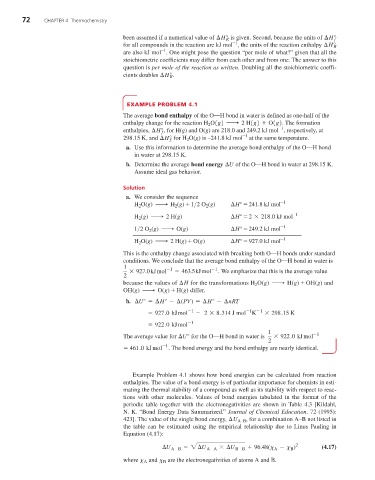
72     CHAPTER 4 Thermochemistry

                                         been assumed if a numerical value of ¢H° R  is given. Second, because the units of ¢H° f
                                                                             -1
                                         for all compounds in the reaction are kJ mol , the units of the reaction enthalpy ¢H° R
                                                      -1
                                         are also kJ mol . One might pose the question “per mole of what?” given that all the
                                         stoichiometric coefficients may differ from each other and from one. The answer to this
                                         question is per mole of the reaction as written. Doubling all the stoichiometric coeffi-
                                         cients doubles ¢H° R .


                                          EXAMPLE PROBLEM 4.1
                                         The average bond enthalpy of the O—H bond in water is defined as one-half of the
                                         enthalpy change for the reaction H O(g) ¡ 2 H(g) + O(g) . The formation
                                                                     2
                                                                                            -1
                                         enthalpies, ¢H° f , for H(g) and O(g) are 218.0 and 249.2 kJ mol , respectively, at
                                         298.15 K, and ¢H° f  for H O(g) is –241.8 kJ mol -1  at the same temperature.
                                                              2
                                          a. Use this information to determine the average bond enthalpy of the O—H bond
                                             in water at 298.15 K.
                                          b. Determine the average bond energy ¢U  of the O—H bond in water at 298.15 K.
                                             Assume ideal gas behavior.

                                         Solution
                                          a. We consider the sequence
                                                                >
                                             H O(g) ¡    H (g) + 12 O (g)   ¢ H° = 241.8 kJ mol -1
                                              2
                                                                    2
                                                          2
                                             H (g) ¡   2 H(g)               ¢ H° = 2 *  218.0 kJ mol -1
                                              2
                                              >
                                             12 O (g) ¡    O(g)             ¢ H° = 249.2 kJ mol -1
                                                  2
                                             H O(g) ¡    2 H(g) + O(g)      ¢ H° = 927.0 kJ mol -1
                                              2
                                         This is the enthalpy change associated with breaking both O—H bonds under standard
                                         conditions. We conclude that the average bond enthalpy of the O—H bond in water is
                                         1             -1             -1
                                           * 927.0kJmol   = 463.5kJmol  . We emphasize that this is the average value
                                         2
                                         because the values of ¢H  for the transformations H O(g) ¡  H(g) + OH(g) and
                                                                                    2
                                         OH(g) ¡    O(g) + H(g) differ.
                                          b. ¢U°  =¢H° -¢(PV) =¢H° -¢nRT
                                                                                 -1
                                                    = 927.0 kJmol -1  -  2 * 8.314 J mol K -1  * 298.15 K
                                                   = 922.0 kJmol -1
                                                                                         1             -1
                                         The average value for ¢U°  for the O—H bond in water is    * 922.0 kJmol
                                                                                        2
                                         = 461.0 kJmol -1 . The bond energy and the bond enthalpy are nearly identical.


                                            Example Problem 4.1 shows how bond energies can be calculated from reaction
                                         enthalpies. The value of a bond energy is of particular importance for chemists in esti-
                                         mating the thermal stability of a compound as well as its stability with respect to reac-
                                         tions with other molecules. Values of bond energies tabulated in the format of the
                                         periodic table together with the electronegativities are shown in Table 4.3 [Kildahl,
                                         N. K. “Bond Energy Data Summarized.” Journal of Chemical Education. 72 (1995):
                                                                            ¢
                                         423]. The value of the single bond energy,  U A–B , for a combination A–B not listed in
                                         the table can be estimated using the empirical relationship due to Linus Pauling in
                                         Equation (4.17):
                                                                                                 2
                                                      ¢U A-B  = 2¢U A-A  *¢U  B-B  + 96.48(x - x )        (4.17)
                                                                                                B
                                                                                          A
                                         where x A  and x B  are the electronegativities of atoms A and B.

