


Page 92 - Physical chemistry eng
P. 92
4.2 INTERNAL ENERGY AND ENTHALPY CHANGES ASSOCIATED WITH CHEMICAL REACTIONS  69

              are very small. The enthalpy of reaction, ¢H R , at specific values of T and P is defined
              as the heat exchanged between the system and the surroundings as the reactants are
              transformed into products at conditions of constant T and P. By convention, heat flow-
              ing into the system is given a positive sign. ¢H R  is, therefore, a negative quantity for
              an exothermic reaction and a positive quantity for an endothermic reaction. The
              standard enthalpy of reaction, ¢H° R , refers to one mole of the specified reaction at a
              pressure of 1 bar, and unless indicated otherwise, to T = 298.15 K.
                 How can the reaction enthalpy and internal energy be determined? We proceed
              in the following way. The reaction is carried out at 1 bar pressure, and the tempera-
              ture change ¢T  that occurs in a finite size water bath, initially at 298.15 K, is meas-
              ured. The water bath is large enough that ¢T  is small. If ¢T  is negative as a result
              of the reaction, the bath is heated to return it, the reaction vessel, and the system to
              298.15 K using an electrical heater. By doing so, we ensure that the initial and final
              states are the same and therefore the measured  ¢H  is equal to  ¢H° R . The electrical
              work done on the heater that restores the temperature of the water bath and the system
              to 298.15 K is equal to  ¢H° R . If the temperature of the water bath increases as a
              result of the reaction, the electrical work done on a heater in the water bath at
              298.15 K that increases its temperature and that of the system by ¢T  in a separate
              experiment is measured. In this case, ¢H° R  is equal to the negative of the electrical
              work done on the heater.
                 Although an experimental method for determining  ¢H° R  has been described, to
              tabulate the reaction enthalpies for all possible chemical reactions would be a monu-
              mental undertaking. Fortunately,  ¢H° R  can be calculated from tabulated enthalpy
              values for individual reactants and products. This is advantageous because there are
              far fewer reactants and products than there are reactions among them. Consider ¢H° R
              for the reaction of Equation (4.1) at T = 298.15 K and P = 1 bar. These values for
              P and T are chosen because thermodynamic values are tabulated for these values.
                           at other values of P and T can be calculated as discussed in Chapters 2
              However, ¢H R
              and 3. In principle, we could express  ¢H° R  in terms of the individual enthalpies of
              reactants and products:
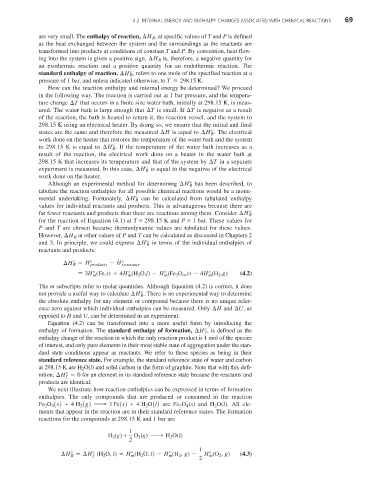
                       ¢H° = H° products  - H° reactants
                         R
                           = 3H° (Fe,s) + 4H° (H O,l) - H° (Fe O ,s) - 4H° (H ,g)  (4.2)
                                                          3 4
                                                                        2
                                                                     m
                                                       m
                                              2
                               m
                                           m
              The m subscripts refer to molar quantities. Although Equation (4.2) is correct, it does
              not provide a useful way to calculate ¢H° R . There is no experimental way to determine
              the absolute enthalpy for any element or compound because there is no unique refer-
              ence zero against which individual enthalpies can be measured. Only ¢H  and ¢U , as
              opposed to H and U, can be determined in an experiment.
                 Equation (4.2) can be transformed into a more useful form by introducing the
              enthalpy of formation. The standard enthalpy of formation, ¢H° f , is defined as the
              enthalpy change of the reaction in which the only reaction product is 1 mol of the species
              of interest, and only pure elements in their most stable state of aggregation under the stan-
              dard state conditions appear as reactants. We refer to these species as being in their
              standard reference state. For example, the standard reference state of water and carbon
              at 298.15 K are H O(l) and solid carbon in the form of graphite. Note that with this defi-
                            2
              nition, ¢H° = 0  for an element in its standard reference state because the reactants and
                      f
              products are identical.
                 We next illustrate how reaction enthalpies can be expressed in terms of formation
              enthalpies. The only compounds that are produced or consumed in the reaction
                                                            O (s) and H O(l). All ele-
              Fe O (s) + 4 H (g) ¡ 3 Fe(s) + 4 H O(l)  are Fe 3 4      2
                           2
                                                 2
                3 4
              ments that appear in the reaction are in their standard reference states. The formation
              reactions for the compounds at 298.15 K and 1 bar are
                                           1
                                    H (g) +  O (g) ¡   H O(l)
                                      2
                                              2
                                                        2
                                           2
                                                                  1
                     ¢H° =¢H° (H O, l) = H° (H O, l) - H° (H , g) -   H° (O , g)  (4.3)
                                                                        2
                                   2
                                                                     m
                        R
                               f
                                            m
                                               2
                                                           2
                                                        m
                                                                  2

