


Page 511 - Pipelines and Risers
P. 511
478                                                              Chapter 25


               q = Usage factor


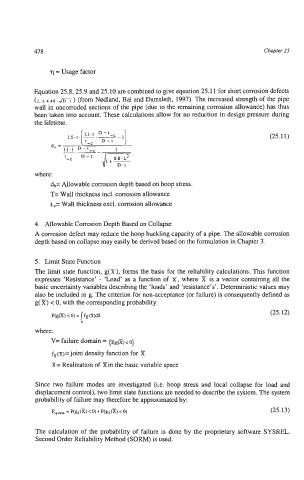
           Equation 25.8,25.9 and 25.10 are combined to give equation 25.11 for short corrosion defects
           ( L  4.48. n) (from NGdland, Bai and Damsleth, 1997). The increased strength of  the pipe
           wall in uncorroded sections of the pipe (due to the remaining corrosion allowance) has thus
           been taken into account. These calculations allow for no reduction in design pressure during
           the lifetime.
                                                                              (25.1 1)
                d,  =
                   1.1-t  D-t-
                   -.c-
                   t-C   D-t
           where:
               dh= Allowable corrosion depth based on hoop stress.
               T= Wall thickness incl. corrosion allowance
               &= Wall thickness excl. corrosion allowance


           4.  Allowable Corrosion Depth Based on Collapse
           A corrosion defect may reduce the hoop buckling capacity of a pipe. The allowable corrosion
           depth based on collapse may easily be derived based on the formulation in Chapter 3.


           5.  Limit State Function
           The limit state function, g(X), forms the basis for the reliability calculations. This function
           expresses ‘Resistance’ -  ‘Load’ as a function of  X, where  X is a vector containing all the
           basic uncertainty variables describing the ‘loads’ and ‘resistance’s’. Deterministic values may
           also be included in g. The criterion for non-acceptance (or failure) is consequently defined as
           g(X) < 0, with the corresponding probability:
                                                                              (25.12)
                P(g(x) < 0) = 5 $(jr)ajC
                        V
           where:
                                     <
                V= failure domain = {qg(x) 0)
                f,(Sr)=  joint density function for X
                51 = Realization of  TT in the basic variable space

           Since two failure modes are investigated (i.e.  hoop stress  and  local collapse for load  and
           displacement control), two limit state functions are needed to describe the system. The system
           probability of failure may therefore be approximated by:
                                                                              (25.13)
                PpyptCm = P(g*(X) c 0) + P(&(X) < 0)

           The calculation of  the probability of  failure is done by  the proprietary software SYSREL.
           Second Order Reliability Method (SORM) used.
                                            is

