


Page 389 - Planning and Design of Airports
P. 389
340     Airp o r t  D e sign


                 of 10 ft. Where there is no operational need for taxiway holding line
                 markings the signs may be installed in the area from the taxiway
                 point of tangency to the location where the holding line markings
                 would be installed [25].
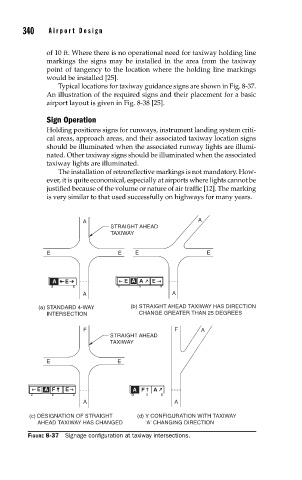
                    Typical locations for taxiway guidance signs are shown in Fig. 8-37.
                 An illustration of the required signs and their placement for a basic
                 airport layout is given in Fig. 8-38 [25].
                 Sign Operation
                 Holding positions signs for runways, instrument landing system criti-
                 cal areas, approach areas, and their associated taxiway location signs
                 should be illuminated when the associated runway lights are illumi-
                 nated. Other taxiway signs should be illuminated when the associated
                 taxiway lights are illuminated.
                    The installation of retroreflective markings is not mandatory. How-
                 ever, it is quite economical, especially at airports where lights cannot be
                 justified because of the volume or nature of air traffic [12]. The marking
                 is very similar to that used successfully on highways for many years.


                           A                               A
                                   STRAIGHT AHEAD
                                   TAXIWAY


                 E                   E   E                   E


                   A  E               E A  A  E
                           A                        A

               (a) STANDARD 4-WAY       (b) STRAIGHT AHEAD TAXIWAY HAS DIRECTION
                 INTERSECTION             CHANGE GREATER THAN 25 DEGREES

                           F                        F      A
                                  STRAIGHT AHEAD
                                  TAXIWAY

                 E                  E


              E A  F  E                  A  F  A
                           A                        A

            (c) DESIGNATION OF STRAIGHT   (d) Y CONFIGURATION WITH TAXIWAY
              AHEAD TAXIWAY HAS CHANGED     ‘A’ CHANGING DIRECTION
            FIGURE 8-37  Signage confi guration at taxiway intersections.

