


Page 424 - Planning and Design of Airports
P. 424
368     Airp o r t  D e sign


                       Supply Curve Nos.
        For paved       2.0
        areas
        For bare                                                         Drainage
        areas
        For turfed      1.5
        areas


              Drainage Area (DA), acres  Permissible Ponding         Length L, ft


                                     Depth at Inlet, ft  Volume 1000 ft 3
                    Unpaved               Pond Area, 1000 ft 2  Volume, ft 3 /acre DA  Average Roughness Factor n  Average Slope S, %  Actual or Effective Length, ft  = 0.40 and   L for n  L Adopted for Selecting Diagrams
             Paved,    Turf                                             Equivalent  = 1%
             n =       n =
        Inlet  0.02  Bare  0.40  Total                                    S
        1    2    3    4     5     6    7    8     9      10   11  12  13   14
        4    5.97      26.81  32.78  3.0  138  206   6,292  0.33  2.0  525  300  300
        3    5.69      25.54  31.23  1.73  145  125   4,016  0.33  2.8  340  200  200
        2    5.69      25.54  31.23  2.73  270  368  11,800  0.33  2.8  340  200  200

       ∗ Not required when appreciable ponding is permissible.
       Source: Corps of Engineers [8].
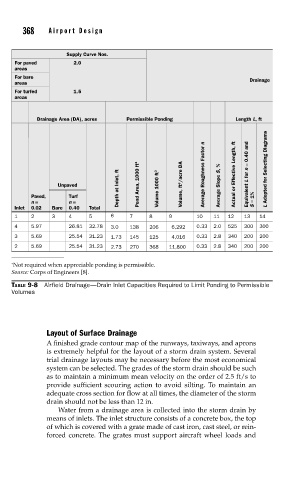
       TABLE 9-8  Airfield Drainage—Drain Inlet Capacities Required to Limit Ponding to Permissible
       Volumes


                 Layout of Surface Drainage
                 A finished grade contour map of the runways, taxiways, and aprons
                 is extremely helpful for the layout of a storm drain system. Several
                 trial drainage layouts may be necessary before the most economical
                 system can be selected. The grades of the storm drain should be such
                 as to maintain a minimum mean velocity on the order of 2.5 ft/s to
                 provide sufficient scouring action to avoid silting. To maintain an
                 adequate cross section for flow at all times, the diameter of the storm
                 drain should not be less than 12 in.
                    Water from a drainage area is collected into the storm drain by
                 means of inlets. The inlet structure consists of a concrete box, the top
                 of which is covered with a grate made of cast iron, cast steel, or rein-
                 forced concrete. The grates must support aircraft wheel loads and

