


Page 425 - Planning and Design of Airports
P. 425
Airport Drainage    369


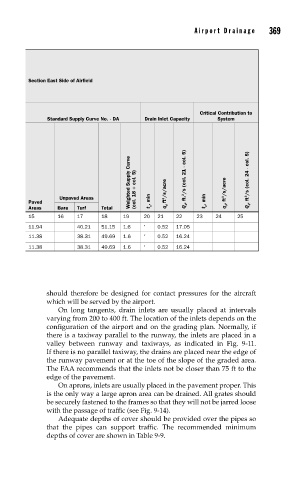
            Section East Side of Airfield


                                                           Critical Contribution to
                 Standard Supply Curve No. ¥ DA  Drain Inlet Capacity  System


                                        Weighted Supply Curve   (col. 18 ÷ col. 5)  Q d , ft. 3 /s (col. 21 ¥ col. 5)  Q d , ft 3 /s (col. 24 ¥ col. 5)


                     Unpaved Areas                ft 3 /s/acre    q d , ft 3 /s/acre
            Paved                            t c , min       t c , min
            Areas   Bare  Turf  Total             q d
            15      16   17     18    19    20  21   22   23   24    25
            11.94        40.21  51.15  1.6  ∗  0.52  17.05
            11.38        38.31  49.69  1.6  ∗  0.52  16.24
            11.38        38.31  49.69  1.6  ∗  0.52  16.24


                 should therefore be designed for contact pressures for the aircraft
                 which will be served by the airport.
                    On long tangents, drain inlets are usually placed at intervals
                 varying from 200 to 400 ft. The location of the inlets depends on the
                 configuration of the airport and on the grading plan. Normally, if
                 there is a taxiway parallel to the runway, the inlets are placed in a
                 valley between runway and taxiways, as indicated in Fig. 9-11.
                 If there is no parallel taxiway, the drains are placed near the edge of
                 the runway pavement or at the toe of the slope of the graded area.
                 The FAA recommends that the inlets not be closer than 75 ft to the
                 edge of the pavement.
                    On aprons, inlets are usually placed in the pavement proper. This
                 is the only way a large apron area can be drained. All grates should
                 be securely fastened to the frames so that they will not be jarred loose
                 with the passage of traffic (see Fig. 9-14).
                    Adequate depths of cover should be provided over the pipes so
                 that the pipes can support traffic. The recommended minimum
                 depths of cover are shown in Table 9-9.

