


Page 218 - Plant design and economics for chemical engineers
P. 218
190  PLANT DESIGN AND ECONOMICS FOR CHEMICAL ENGINEERS

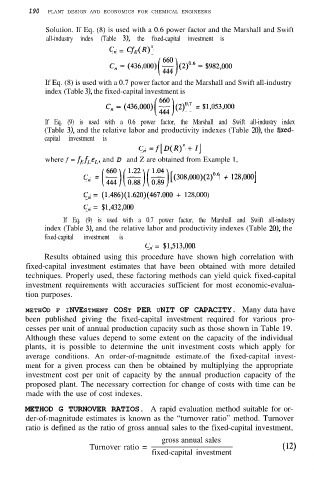
             Solution. If Eq. (8) is used with a 0.6 power factor and the Marshall and Swift
             all-industry index (Table  3),  the fixed-capital investment is
                             c,  = CfEW”


             If Eq. (8) is used with a 0.7 power factor and the Marshall and Swift all-industry
             index (Table 3), the fixed-capital investment is
                                              (2)".'  = $1,053,000

             If Eq. (9) is used with a 0.6 power factor, the Marshall and Swift all-industry index
            (Table 3), and the relative labor and productivity indexes (Table  20), the fixed-
            capital  investment  is
                                     C”  =f[D(R)”  -t I]
             where f = fEfLe,,  and D and Z are obtained from Example 1,

                      C, = (~)(~)(~)[(308,000)(2)".6 + 128,000]
                      C,  = (1.486)(1.620)(467.000  + 128,000)
                      C,  = $1,432,000
                 If Eq. (9) is used with a 0.7 power factor, the Marshall and Swift all-industry
            index (Table 3), and the relative labor and productivity indexes (Table 20),  the
            fixed-capital  investment  is
                                      C”  = $1,513,000
            Results obtained using this procedure have shown high correlation with
        fixed-capital investment estimates that have been obtained with more detailed
        techniques. Properly used, these factoring methods can yield quick fixed-capital
        investment requirements with accuracies sufficient for most economic-evalua-
        tion purposes.

        METHOD  F  INVESTMENT COST PER UNIT OF CAPACITY. Many data have
       been published giving the fixed-capital investment required for various pro-
        cesses per unit of annual production capacity such as those shown in Table 19.
       Although these values depend to some extent on the capacity of the individual
       plants, it is possible to determine the unit investment costs which apply for
        average conditions. An order-of-magnitude estimate.of the fixed-capital invest-
        ment  for a given process can then be obtained by multiplying the appropriate
        investment cost per unit of capacity by the annual production capacity of the
        proposed plant. The necessary correction for change of costs with time can be
        made with the use of cost indexes.
       METHOD G TURNOVER RATIOS.  A rapid evaluation method suitable for or-
        der-of-magnitude estimates is known as the “turnover ratio” method. Turnover
        ratio is defined as the ratio of gross annual sales to the fixed-capital investment,
                                          gross annual sales
                        Turnover ratio =                                 (14
                                        fixed-capital investment

