


Page 162 - Plastics Engineering
P. 162
Mechanical Behaviour of Plastics                                145

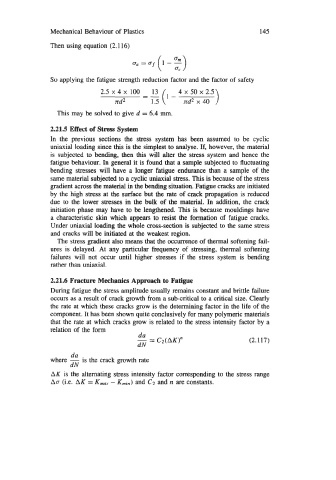
                Then using equation (2.116)
                                         a, =uf (1  - 2)


                So applying the fatigue strength reduction factor and the factor of  safety
                               2.5 x 4 x  100 - 13   - 4 x 50 x 2.5)
                                    nd2        1.5      nd2 x  40
                  This may be solved to give d = 6.4 mm.


                2.21.5 Effect of Stress System
                In  the  previous  sections the  stress  system  has  been  assumed  to  be  cyclic
                uniaxial loading since this is the simplest to analyse. If, however, the material
                is  subjected to bending, then  this will alter the stress system and hence the
                fatigue behaviour. In general it is found that a sample subjected to fluctuating
                bending  stresses will  have a  longer fatigue endurance than  a  sample of  the
                same material subjected to a cyclic uniaxial stress. This is because of the stress
                gradient across the material in the bending situation. Fatigue cracks are initiated
                by  the high stress at the surface but the rate of  crack propagation is reduced
                due to  the  lower stresses in  the bulk  of  the material. In  addition, the crack
                initiation phase may  have to be lengthened. This is because mouldings have
                a characteristic skin which appears to resist the formation of  fatigue cracks.
                Under uniaxial loading the whole cross-section is subjected to the same stress
                and cracks will be initiated at the weakest region.
                  The stress gradient also means that the occurrence of thermal softening fail-
                ures  is  delayed.  At  any  particular  frequency of  stressing, thermal  softening
                failures  will  not  occur  until  higher  stresses if  the  stress system is  bending
                rather than uniaxial.

                2.21.6 Fracture Mechanics Approach to Fatigue
                During fatigue the stress amplitude usually remains constant and brittle failure
                occurs as a result of crack growth from a sub-critical to a critical size. Clearly
                the rate at which these cracks grow is the determining factor in the life of the
                component. It has been shown quite conclusively for many polymeric materials
                that the rate at which cracks grow is related to the stress intensity factor by  a
                relation of  the form
                                           da
                                              -
                                          _- Cz(AK)"                        (2.1 17)
                                           dN
                      da
                where - the crack growth rate
                          is
                      dN
                AK is the alternating stress intensity factor corresponding to the stress range
                Au (Le. AK = K,,  - Kmin) and C2  and n  are constants.

