


Page 172 - Plastics Engineering
P. 172
Mechanical Behaviour of  Plastics                               155

                  During these types of  test it is the energy absorbed at fracture, U,, which
               is recorded. In terms of the applied force, F,,  and sample deformation, 6, this
               will be given by
                                            U, = iF,S                       (2.121)
                or expressing this in terms of the compliance, from equation (2.90)

                                            U, = iF:C                       (2.122)
                  Now, from equation (2.91) we have the expression for the toughness, G,,  of
                the material
                                                 FZ  aC
                                           G  -__
                                             ‘-2Btk2
                So using equation (2.122) and introducing the material width, D

                                                  uc
                                            G --                            (2.123)
                                               -  BD0
                where  0 = ((l/C)(i3C/&z))-1. This is  a geometrical function which can  be
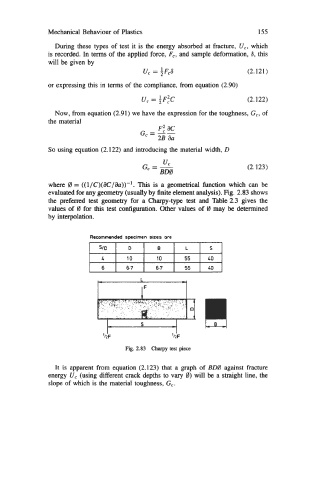
                evaluated for any geometry (usually by finite element analysis). Fig. 2.83 shows
                the  preferred  test  geometry for  a  Charpy-type test  and Table 2.3  gives  the
                values of  0 for this test configuration. Other values of  0 may  be  determined
               by interpolation.


                            Recommended specimen  sizes  are


                                       6.7      6.7      55
                                           L
                                            IF


                                       Fig. 2.83  Charpy test piece

                  It  is  apparent from equation (2.123) that  a  graph of  BDO  against fracture
                energy U, (using different crack depths to vary 0) will be a straight line, the
                slope of which is the material toughness, G,.

