


Page 143 - Practical Control Engineering a Guide for Engineers, Managers, and Practitioners
P. 143
118   Chapter  Four


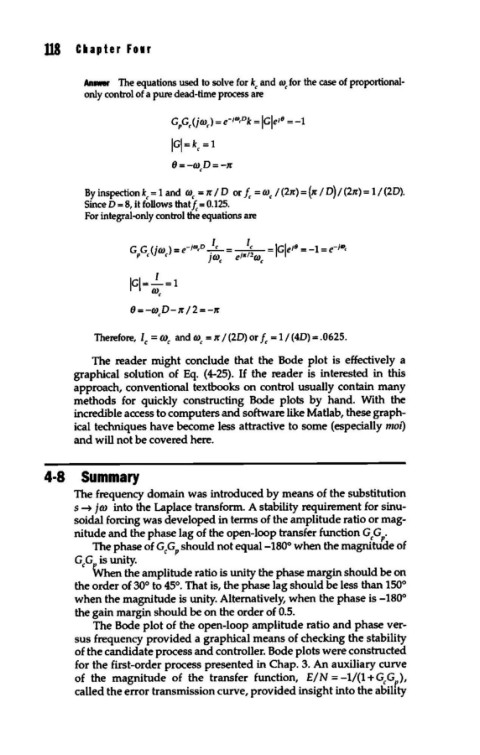
               Answer  The equations used to solve for kc and me for the case of proportional-
               only control of a pure dead-time process are

                                         0
                                                8
                              G,Gc(jwc) = e-J"', k = 1Gie' =  -1
                              IGI=kc = 1


               By inspection kc =  1 and  CIJc  = tr I D  or fc  =  CIJc I (2tr) =  (tr I D) I (2tr) = 1 I (2D).
               Since D =  8, it follows that  fc =  0.125.
               For integral-only control the equations are


                 Therefore,  I, = m,  and CtJc  = tr I (2D) or fc  = 1 I (4D) =  .0625.
                The  reader might conclude  that  the  Bode  plot is  effectively  a
             graphical solution of  Eq.  (4-25).  If  the  reader is  interested  in this
             approach, conventional textbooks on control usually contain many
             methods  for  quickly  constructing  Bode  plots  by  hand.  With  the
             incredible access to computers and software like Matlab, these graph-
             ical techniques have become less attractive to some (especially mor)
             and will not be covered here.


        4-8  Summary
             The frequency domain was introduced by means of the substitution
             s ~  jm  into the Laplace transform. A stability requirement for sinu-
             soidal forcing was developed in terms of the amplitude ratio or mag-
             nitude and the phase lag of the open-loop transfer function G,GP.
                The phase of G,GP should not equal-180° when the magnitude of
             G,G  is unity.
                When the amplitude ratio is unity the phase margin should be on
             the order of 30° to 45°. That is, the phase lag should be less than 150°
             when the magnitude is unity. Alternatively, when the phase is -180°
             the gain margin should be on the order of 0.5.
                The Bode plot of the open-loop amplitude ratio and phase ver-
             sus frequency provided a graphical means of checking the stability
             of the candidate process and controller. Bode plots were constructed
             for the first-order process presented in Chap. 3. An auxiliary curve
             of  the  magnitude  of  the  transfer  function,  E/N = -1/(1 +  G,Gl'),
             called the error transmission curve, provided insight into the abihty

