


Page 141 - Practical Control Engineering a Guide for Engineers, Managers, and Practitioners
P. 141
116   Chapter  Fonr


                Now, the problem is to find n such that the right-hand side of
             Eq. (4-24) equals L. This can be done quickly with an iterative method
             of the engineer's choosing.
                This situation has actually occurred in my experience and this
             algorithm does in fact work. I suggest that this is a good example of
             using simple calculus to solve a problem that is often overlooked.


        4-7  Partial Summary and a Slight Modification
              of the Rule of Thumb
             Our approach has been to find a proportional control gain, called the
             critical gain, that makes the open-loop amplitude ratio unity or the
             open-loop phase lag 180°. In the former case we reduce the critical
             proportional control gain to make the phase lag less than 180° by
             about 45°. In  the latter case we reduce the critical proportional control
             gain by a factor of 0.5.
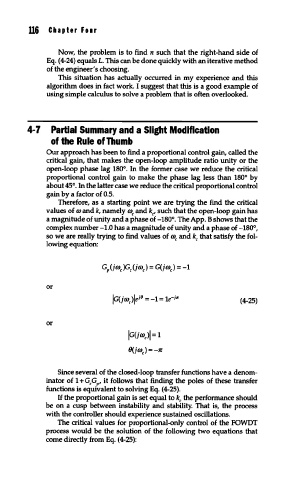
                Therefore, as a  starting point we are trying the find the critical
             values of m  and k, namely m, and k,, such that the open-loop gain has
             a magnitude of unity and a phase of -180°. The App. B shows that the
             complex number -1.0 has a magnitude of unity and a phase of -180°,
             so we are really trying to find values of m, and k, that satisfy the fol-
             lowing equation:


             or

                                                                (4-25)

             or
                                   IG(j mc>l = 1

                                   9(jm,) = -n

                Since several of the closed-loop transfer functions have a denom-
             inator of 1  +  G,G,, it follows that finding the poles of these transfer
             functions is equivalent to solving Eq. (4-25).
                If the proportional gain is set equal to k, the performance should
             be on a  cusp between instability and stability. That is,  the process
             with the controller should experience sustained oscillations.
                The critical values for proportional-only control of the FOWDT
             process would be the solution of the following two equations that
             come directly from Eq. (  4-25):

