


Page 136 - Practical Control Engineering a Guide for Engineers, Managers, and Practitioners
P. 136
A New  Do11ain  and  More  Process  Models  m


             4·5·3  Proportional-Integral Control of the FOWDT Process
             Adding integral  control causes  the open-loop  transfer function  to
             become

                                     _  -sD  g  ks +I
                               G G (  )  s  -e  ----
                                pc        -rs+l  s
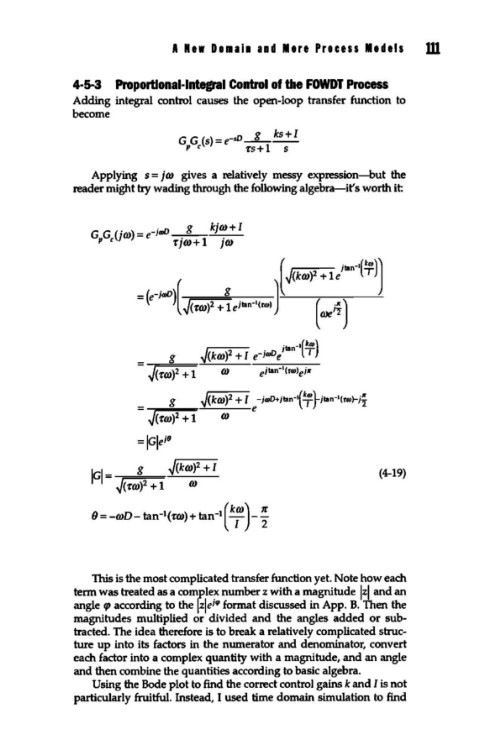
                Applying  s  = jro  gives  a  relatively  messy  expression-but the
             reader might try wading through the following algebra-it's worth it:


                G G ('ro)=e-it»D_g_kjro+I
                 p  c  J      t'jOJ+ 1  jOJ


                                  ~(kro)2  +I e-itoO/tan-•(~)
                        =    g
                                                1
                          ~(  -rro)2 + 1   OJ   eitan- (r<»>ei~r
                        =    g    ~(kro)2 +I e-jcoD+jtan-•(k~}jtan-•(r<»Hi
                              2
                          ~(-rro) + 1   OJ
                        =  1Giei9

                                  2
                G _     g    ~(kro) +I                          (4-19)
                I 1- ~(  -rro)2 +  1   ro

                                       k(J))  tr
                8= -roD- tan- (-rro)+ tan- -I- -2
                                      (
                                     1
                            1

                This is the most complicated transfer function yet. Note how each
             term was treated as a compte~  number z  with a magnitude lzl and an
             angle cp  according to the 1zleJ" format discussed in App. B. Then the
             magnitudes  multiplied  or divided  and  the  angles  added  or sub-
             tracted. The idea therefore is to break a relatively complicated struc-
             ture up into its factors in the numerator and denominator, convert
             each factor into a complex quantity with a magnitude, and an angle
             and then combine the quantities according to basic algebra.
                Using the Bode plot to find the correct control gains k and I is not
             particularly fruitful. Instead, I used time domain simulation to find

