


Page 137 - Practical Control Engineering a Guide for Engineers, Managers, and Practitioners
P. 137
112   Chapter  Four


                 0.7
                 0.6             . . .   ...
                 0.5
                 0.4
              :::s
                 0.3                                ..
                 0.2
                 0.1
                  0
                   0    10   20   30   40   50   60   70   80   90   100

                  2
                 1.5
               V)
              "'0
               c::   1               -·-·- --·
               <U
               >-

                                     40   50   60   70   80   90   100
                                         Time

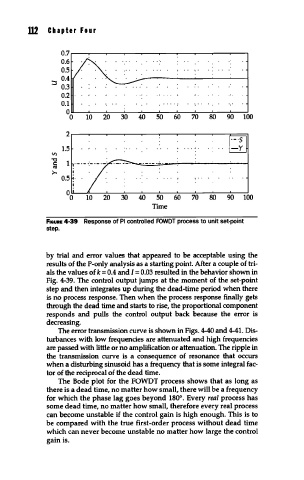
             F•auRE 4-39  Response of PI controlled FOWDT process to unit set-point
             step.


             by trial and error values that appeared  to be acceptable using the
             results of the P-only analysis as a starting point. After a couple of tri-
             als the values of k = 0.4 and I=  0.03 resulted in the behavior shown in
             Fig.  4-39. The control output jumps at the moment of the set-point
             step and then integrates up during the dead-time period when there
             is no process response. Then when the process response finally gets
             through the dead time and starts to rise, the proportional component
             responds  and  pulls  the  control  output back  because  the  error  is
             decreasing.
                The error transmission curve is shown in Figs. 4-40 and 4-41. Dis-
             turbances with low frequencies are attenuated and high frequencies
             are passed with little or no amplification or attenuation. The ripple in
             the  transmission curve  is  a  consequence  of resonance  that occurs
             when a disturbing sinusoid has a frequency that is some integral fac-
             tor of the reciprocal of the dead time.
                The Bode plot for  the FOWDT process shows that as long as
             there is a dead time, no matter how small, there will be a frequency
             for which the phase lag goes beyond 180°. Every real  process has
             some dead time, no matter how small, therefore every real process
             can become unstable if the control gain is high enough. This is to
             be compared with the true first-order process without dead time
             which can never become unstable no matter how large the control
             gain is.

