


Page 335 - Radar Technology Encyclopedia
P. 335
325   radar, aircraft tail-protection                                    radar, airport surveillance (ASR)


                                                                narrow pulse (20 to 50 ns), narrow beam (0.25° to 0.4°), and
                                                                rapid scan rate (60 rpm or greater), with display ranges from
                                                                one to 5 km. The resolution is intended to be adequate to pro-
                                                                vide recognition of different  classes  of aircraft, as well  as
                                                                resolving one aircraft from another as they stand in taxiways
                                                                at the end of an active runway. The radar must also detect and
                                                                display automobiles and trucks operating on or near taxiways.
                                                                Rain clutter presents a problem  at the  high microwave  fre-
                                                                quencies used, and this is minimized by  using a  circularly
                                                                polarized antenna.
                                                                    The newer generation of ASDEs used in the United
                                                                States is represented by the ASDE-3, the parameters of which
                                                                are listed in Table R1. DKB
                                                                IEEE (1993), p. 23; Skolnik (1988), pp. 116–126.


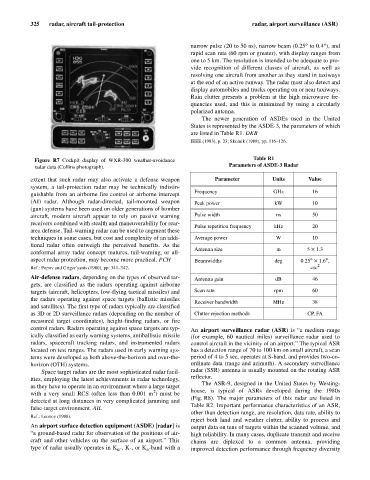
            Figure R7  Cockpit display of WXR-300  weather-avoidance                 Table R1
            radar data (Collins photograph).                                 Parameters of ASDE-3 Radar

           extent that such  radar may also  activate  a defense  weapon  Parameter        Units       Value
           system, a tail-protection  radar may  be technically indistin-
                                                                 Frequency                 GHz          16
           guishable from an airborne fire control or airborne intercept
           (AI) radar. Although radar-directed,  tail-mounted weapon  Peak power            kW          10
           (gun) systems have been used on older generations of bomber
           aircraft, modern aircraft appear  to  rely  on passive warning  Pulse width      ns          50
           receivers combined with stealth and maneuverability for rear-
                                                                 Pulse repetition frequency  kHz        20
           area defense. Tail-warning radar can be used to augment these
           techniques in some cases, but cost and complexity of an addi-  Average power     W           10
           tional radar  often  outweigh the perceived benefits. As the
                                                                 Antenna size               m         5 ´  1.3
           conformal array radar concept matures, tail-warning, or all-
           aspect radar protection, may become more practical. PCH  Beamwidths              deg     0.25° ´ ° ,
                                                                                                          1.6
                                                                                                          2
           Ref.: Popov and Grigor'yants (1980), pp. 341–342.                                            csc
           Air-defense radars, depending on the types of observed tar-  Antenna gain        dB          46
           gets,  are classified as the  radars operating  against  airborne
           targets (aircraft, helicopters, low-flying tactical missiles) and  Scan rate     rpm         60
           the radars operating against space targets (ballistic missiles
                                                                 Receiver bandwidth        MHz          38
           and satellites). The first type of radars typically are classified
           as 3D or 2D surveillance radars (depending on the number of  Clutter rejection methods      CP, FA
           measured target coordinates), height-finding radars, or fire
           control radars. Radars operating against space targets are typ-  An  airport surveillance radar (ASR) is “a medium-range
           ically classified as early warning systems, antiballistic missile  (for  example,  60 nautical miles) surveillance  radar used  to
           radars, spacecraft tracking  radars,  and  instrumented radars  control aircraft in the vicinity of an airport.” The typical ASR
           located on test ranges. The radars used in early warning sys-  has a detection range of 70 to 100 km on small aircraft, a scan
           tems were developed as both above-the-horizon and over-the-  period of 4 to 5 sec, operates at S-band, and provides two-co-
           horizon (OTH) systems.                               ordinate data (range and azimuth). A secondary surveillance
               Space target radars are the most sophisticated radar facil-  radar (SSR) antenna is usually mounted on the rotating ASR
                                                                reflector.
           ities, employing the latest achievements in radar technology,
                                                                    The ASR-9, designed in the United States by Westing-
           as they have to operate in an environment where a large target
                                                    2
           with a very small RCS (often less than 0.001 m ) must be  house, is typical of ASRs developed  during the 1980s
                                                                (Fig. R8). The  major parameters of this radar  are listed  in
           detected at long distances in very complicated jamming and
                                                                Table R2. Important performance characteristics of an ASR,
           false-target environment. AIL
                                                                other than detection range, are resolution, data rate, ability to
           Ref.: Leonov (1988).
                                                                reject both  land and  weather clutter, ability to process  and
           An airport surface detection equipment (ASDE) [radar] is  output data on tens of targets within the scanned volume, and
           “a ground-based radar for observation of the positions of air-  high reliability. In many cases, duplicate transmit and receive
           craft and other vehicles on the surface of an airport.” This  chains  are diplexed to a common  antenna, providing
           type of radar usually operates in K -, K-, or K -band with a  improved detection performance through frequency diversity
                                                 a
                                        u

