


Page 337 - Radar Technology Encyclopedia
P. 337
327   radar, air-route-surveillance (ARSR)                             radar, artillery and mortar location


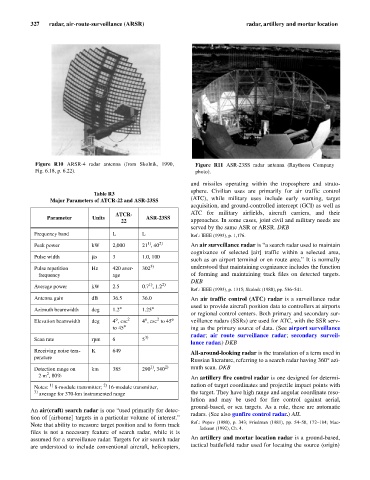
             Figure R10  ARSR-4 radar antenna  (from  Skolnik, 1990,  Figure R11  ASR-23SS radar antenna (Raytheon Company
             Fig. 6.18, p. 6.22).                                 photo).

                                                                and  missiles operating  within the troposphere and strato-
                                                                sphere.  Civilian uses are primarily for  air traffic control
                                Table R3
                                                                (ATC), while military uses include early warning, target
                  Major Parameters of ATCR-22 and ASR-23SS
                                                                acquisition, and ground-controlled intercept (GCI) as well as
                                       ATCR-                    ATC for military airfields,  aircraft carriers, and their
                 Parameter      Units            ASR-23SS
                                         22                     approaches. In some cases, joint civil and military needs are
                                                                served by the same ASR or ARSR. DKB
            Frequency band            L         L               Ref.: IEEE (1993), p. 1,176.
                                                  1)  2)
            Peak power         kW     2,000     21 , 40         An air surveillance radar is “a search radar used to maintain
                                                                cognizance of selected [air] traffic within  a selected area,
            Pulse width        m s    3         1.0, 100
                                                                such as an airport terminal or en route area.” It is normally
            Pulse repetition   Hz     420 aver-  302 3)         understood that maintaining cognizance includes the function
              frequency               age                       of forming and maintaining track files on  detected targets.
                                                                DKB
                                                  1)
            Average power      kW     2.5       0.7 , 1.2 2)
                                                                Ref.: IEEE (1993), p. 1315; Skolnik (1980), pp. 536–541.
            Antenna gain       dB     36.5      36.0            An air traffic control (ATC) radar is a surveillance radar
                                                                used to provide aircraft position data to controllers at airports
            Azimuth beamwidth  deg    1.2°      1.25°
                                                                or regional control centers. Both primary and secondary sur-
                                           2         2
            Elevation beamwidth  deg  4° , csc    4° , csc  to 45°  veillance radars (SSRs) are used for ATC, with the SSR serv-
                                      to 45°                    ing as the primary source of data. (See airport surveillance
                                                                radar;  air route  surveillance radar;  secondary surveil-
                                                 3)
            Scan rate          rpm    6         5
                                                                lance radar.) DKB
            Receiving noise tem-  K   649                       All-around-looking radar is the translation of a term used in
            perature
                                                                Russian literature, referring to a search radar having 360° azi-
                                                   1)  2)       muth scan. DKB
            Detection range on   km   385       290 , 340
                2
              2m , 80%                                          An artillery fire control radar is one designed for determi-
                 1)                2)                           nation of target coordinates and projectile impact points with
            Notes:   8-module transmitter;   16-module transmitter,
            3)                                                  the target. They have high range and angular coordinate reso-
               average for 370-km instrumented range
                                                                lution and may  be used for fire control  against aerial,
                                                                ground-based, or sea targets. As a rule, these are automatic
           An air(craft) search radar is one “used primarily for detec-
                                                                radars. (See also gunfire control radar.) AIL
           tion of [airborne] targets in a particular volume of interest.”
                                                                Ref.: Popov (1980), p. 343; Friedman (1981), pp. 54–58,  172–184;  Mac-
           Note that ability to measure target position and to form track
                                                                   fadzean (1992), Ch. 4.
           files  is  not a necessary feature  of search radar, while it  is
           assumed for a surveillance radar. Targets for air search radar  An artillery and mortar location radar is a ground-based,
           are understood to include conventional aircraft, helicopters,  tactical battlefield radar used for locating the source (origin)

