


Page 332 - Radar Technology Encyclopedia
P. 332
radar, aerostat                                                 radar, airborne-early-warning (AEW)  322


           tude or surface targets. Power for the radar can be supplied,  craft tail-protection radar; doppler radar; synthetic aper-
           and data returned to the surface station, through the tethering  ture radar.) PCH
           cable. The operational difficulties of maintaining the aerostat  Ref.: Povejsil (1961); Stimson (1983); Morris (1988); Morchin (1990); Neri
           in position under harsh weather conditions have precluded  (1991), p. 175; Long (1992).
           most military exploitations of aerostat radars, but some suc-  An airborne early warning (AEW) radar is carried by an
           cess has been achieved in application to border surveillance,  airborne or spaceborne platform whose function is the detec-
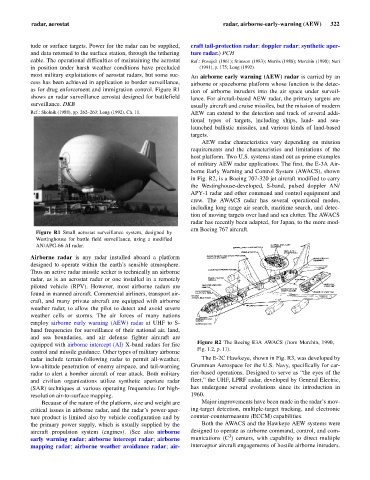
           as for drug enforcement and immigration control. Figure R1  tion of airborne  intruders into  the air  space  under surveil-
           shows an radar surveillance aerostat designed for battlefield  lance. For aircraft-based AEW radar, the primary targets are
           surveillance. DKB                                    usually aircraft and cruise missiles, but the mission of modern
           Ref.: Skolnik (1988), pp. 262–263; Long (1992), Ch. 11.  AEW can extend to the detection and track of several addi-
                                                                tional types of  targets, including ships, land- and sea-
                                                                launched ballistic missiles, and various kinds of land-based
                                                                targets.
                                                                    AEW radar characteristics vary  depending on mission
                                                                requirements  and the  characteristics  and limitations of the
                                                                host platform. Two U.S. systems stand out as prime examples
                                                                of military AEW radar applications. The first, the E-3A Air-
                                                                borne Early Warning and Control System (AWACS), shown
                                                                in Fig. R2, is a Boeing 707-320 jet aircraft modified to carry
                                                                the  Westinghouse-developed, S-band, pulsed doppler AN/
                                                                APY-1 radar and other command and control equipment and
                                                                crew. The AWACS  radar has several operational modes,
                                                                including long range air search, maritime search, and detec-
                                                                tion of moving targets over land and sea clutter. The AWACS
                                                                radar has recently been adapted, for Japan, to the more mod-
                                                                ern Boeing 767 aircraft.
             Figure R1  Small aerostat surveillance  system, designed  by
             Westinghouse  for battle field  surveillance, using a  modified
             AN/APG-66 AI radar.

           Airborne radar is any radar installed  aboard a platform
           designed to operate within  the  earth’s sensible atmosphere.
           Thus an active radar missile seeker is technically an airborne
           radar, as is an aerostat radar or one installed in a remotely
           piloted vehicle  (RPV). However, most  airborne radars  are
           found in manned aircraft. Commercial airliners, transport air-
           craft, and many private aircraft are equipped with airborne
           weather radar, to allow the pilot to detect and avoid severe
           weather  cells or storms. The air forces of many nations
           employ  airborne  early warning (AEW) radar at UHF to S-
           band frequencies for surveillance of their national air, land,
           and sea boundaries, and air defense fighter aircraft are
           equipped with airborne intercept (AI) X-band radars for fire  Figure R2 The Boeing E3A AWACS (from Morchin, 1990,
                                                                  Fig. 1.2, p. 11).
           control and missile guidance. Other types of military airborne
           radar include  terrain-following  radar to permit  all-weather,  The E-2C Hawkeye, shown in Fig. R3, was developed by
           low-altitude penetration of enemy airspace, and tail-warning  Grumman Aerospace for the U.S. Navy, specifically for car-
           radar to alert a bomber aircraft of rear attack. Both military  rier-based operations. Designed to serve as “the eyes of the
           and civilian  organizations utilize  synthetic aperture radar  fleet,” the UHF, LPRF radar, developed by General Electric,
           (SAR) techniques at various operating frequencies for high-  has undergone several  evolutions  since its introduction in
           resolution air-to-surface mapping.                   1960.
               Because of the nature of the platform, size and weight are  Major improvements have been made in the radar’s mov-
           critical issues in airborne radar, and the radar’s power-aper-  ing-target  detection, multiple-target  tracking, and electronic
           ture product is limited also by vehicle configuration and by  counter-countermeasure (ECCM) capabilities.
           the primary power supply, which is usually supplied by the  Both the AWACS and the Hawkeye AEW systems were
           aircraft propulsion  system (engines).  (See also  airborne  designed to operate as airborne command, control, and com-
                                                                             3
           early warning radar; airborne intercept radar; airborne  munications (C ) centers, with  capability to direct multiple
           mapping radar;  airborne weather avoidance radar;  air-  interceptor aircraft engagements of hostile airborne intruders.

