


Page 329 - Radar Technology Encyclopedia
P. 329
319   pulse repetition frequency, high (HPRF)                                                 PULSER


           staggered PRFs. HPRF pulsed doppler radars at X-band typi-  target may be unresolvable in doppler. Such conditions can
           cally operate at PRFs from 100 kHz to over 300 kHz, at duty  regularly occur for slowly moving and receding targets.
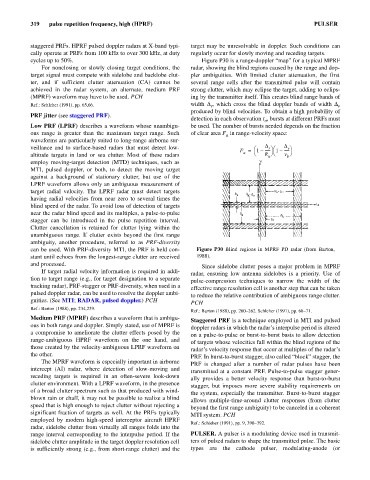
           cycles up to 50%.                                        Figure P30 is a range-doppler “map” for a typical MPRF
               For nonclosing or slowly closing target conditions, the  radar, showing the blind regions caused by the range and dop-
           target signal must compete with sidelobe and backlobe clut-  pler ambiguities.  With limited clutter attenuation, the first
           ter, and if sufficient  clutter  attenuation (CA)  cannot be  several range  cells after the transmitted pulse will contain
           achieved  in  the radar system, an alternate, medium  PRF  strong clutter, which may eclipse the target, adding to eclips-
           (MPRF) waveform may have to be used. PCH             ing by the transmitter itself. This creates blind range bands of
           Ref.: Schleher (1991), pp. 65,66.                    width  D , which cross the blind doppler bands of width  D v
                                                                       r
                                                                produced by blind velocities. To obtain a high probability of
           PRF jitter (see staggered PRF).
                                                                detection in each observation t , bursts at different PRFs must
                                                                                        o
           Low PRF (LPRF) describes a waveform whose unambigu-  be used. The number of bursts needed depends on the fraction
           ous range is greater than the maximum target range. Such  of clear area F  in range-velocity space:
                                                                            a
           waveforms are particularly suited to long-range airborne sur-
           veillance and to surface-based radars that must detect low-               æ   D r öæ  D v ö
                                                                                F =   1 –  ------ 1 –  -----
                                                                                 a
           altitude targets in land  or sea clutter. Most of these radars            è  R øè   v ø
                                                                                          u
                                                                                                b
           employ moving-target detection (MTD) techniques, such as
           MTI, pulsed  doppler, or both, to detect  the moving target
           against  a background of  stationary clutter, but use of  the
           LPRF waveform allows only an ambiguous measurement of
           target radial  velocity. The LPRF radar  must detect  targets
           having radial velocities from near zero to several times the
           blind speed of the radar. To avoid loss of detection of targets
           near the radar blind speed and its multiples, a pulse-to-pulse
           stagger can  be introduced in  the pulse  repetition  interval.
           Clutter cancellation  is retained for  clutter lying within  the
           unambiguous range.  If  clutter exists beyond the first range
           ambiguity, another  procedure,  referred to as  PRF-diversity
           can be used. With PRF-diversity MTI, the PRF is held con-  Figure P30  Blind regions in MPRF  PD radar  (from Barton,
           stant until echoes from the longest-range clutter are received  1988).
           and processed.
                                                                    Since sidelobe clutter poses a major problem in MPRF
               If target radial velocity information is required in addi-
                                                                radar, ensuring  low antenna sidelobes is a priority. Use of
           tion to target range (e.g., for target designation to a separate
                                                                pulse-compression techniques to narrow the width of the
           tracking radar), PRF-stagger or PRF-diversity, when used in a
                                                                effective range resolution cell is another step that can be taken
           pulsed doppler radar, can be used to resolve the doppler ambi-
                                                                to reduce the relative contribution of ambiguous range clutter.
           guities. (See MTI; RADAR, pulsed doppler.) PCH
                                                                PCH
           Ref.: Barton (1988), pp. 234,239.
                                                                Ref.: Barton (1988), pp. 260–262. Schleher (1991), pp. 68–71.
           Medium PRF (MPRF) describes a waveform that is ambigu-
                                                                Staggered PRF is a technique employed in MTI and pulsed
           ous in both range and doppler. Simply stated, use of MPRF is
                                                                doppler radars in which the radar’s interpulse period is altered
           a compromise to ameliorate the clutter effects posed by the
                                                                on a pulse-to-pulse or burst-to-burst basis to allow detection
           range-ambiguous HPRF waveform on the one hand, and
                                                                of targets whose velocities fall within the blind regions of the
           those created by the velocity-ambiguous LPRF waveform on
                                                                radar’s velocity response that occur at multiples of the radar’s
           the other.
                                                                PRF. In burst-to-burst stagger, also called “block” stagger, the
               The MPRF waveform is especially important in airborne
                                                                PRF  is  changed after  a number of radar  pulses have been
           intercept (AI) radar, where detection of slow-moving and
                                                                transmitted at a constant PRF. Pulse-to-pulse stagger gener-
           receding targets is required in an  often-severe look-down
                                                                ally provides a better  velocity  response  than burst-to-burst
           clutter environment. With a LPRF waveform, in the presence
                                                                stagger, but imposes more  severe  stability requirements  on
           of a broad clutter spectrum such as that produced with wind-
                                                                the system, especially the transmitter. Burst-to-burst stagger
           blown rain or chaff, it may not be possible to realize a blind
                                                                allows multiple-time-around clutter responses (from  clutter
           speed that is high enough to reject clutter without rejecting a
                                                                beyond the first range ambiguity) to be canceled in a coherent
           significant fraction of targets as well. At the PRFs typically
                                                                MTI system. PCH
           employed by modern  high-speed interceptor aircraft HPRF
                                                                Ref.: Schleher (1991), pp. 9, 390–392.
           radar, sidelobe clutter from virtually all ranges folds into the
           range interval corresponding to the interpulse period. If the  PULSER. A pulser is a modulating device used in transmit-
           sidelobe clutter amplitude in the target doppler resolution cell  ters of pulsed radars to shape the transmitted pulse. The basic
           is sufficiently strong (e.g., from short-range clutter) and the  types are the cathode pulser, modulating-anode (or

