


Page 325 - Radar Technology Encyclopedia
P. 325
315   pulse, uncoded [simple]                                                  pulse compression, analog


                                                                frequency, which would result in decreasing the unambiguous
                                                                range; since the long pulse is used on transmit, increased dop-
                                                                pler resolution is possible; when coded waveforms are used, a
                                                                radar is less vulnerable to interference. The cost to be paid for
                                                                these advantages  is greater complexity relative  to  simple
                                                                pulse transmissions, complexity of pulse-compression wave-
                                                                form generation and processing, all increasing the cost of the
                                                                radar system. SAL
                                                                Ref.: IEEE (1990), p. 23; Barton (1988), pp. 220–230; Barton (1991),
                                                                   pp. 7.2–7.31; Skolnik (1980), pp. 420–434; Skolnik (1990), pp. 10.1–
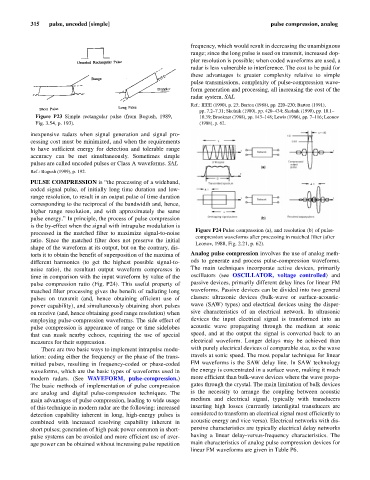
             Figure P23  Simple  rectangular pulse (from  Bogush, 1989,  10.39; Brookner (1988), pp. 143–148; Lewis (1986), pp. 7–116; Leonov
             Fig. 3.54, p. 193).                                   (1988), p. 62.
           inexpensive radars when signal generation  and signal pro-
           cessing cost must be minimized, and when the requirements
           to have sufficient energy for detection  and tolerable range
           accuracy  can  be met simultaneously. Sometimes  simple
           pulses are called uncoded pulses or Class A waveforms. SAL
           Ref.: Bogush (1989), p. 192.
           PULSE COMPRESSION is “the processing of a wideband,
           coded signal pulse, of initially long time duration and low-
           range resolution, to result in an output pulse of time duration
           corresponding to the reciprocal of the bandwidth and, hence,
           higher range resolution, and with approximately the same
           pulse energy.” In principle, the process of pulse compression
           is the by-effect when the signal with intrapulse modulation is
                                                                  Figure P24 Pulse compression (a), and resolution (b) of pulse-
           processed in the matched filter  to maximize signal-to-noise
                                                                  compression waveforms after processing in matched filter (after
           ratio. Since  the matched  filter does  not preserve  the initial
                                                                  Leonov, 1988, Fig. 2.21, p. 62).
           shape of the waveform at its output, but on the contrary, dis-
           torts it to obtain the benefit of superposition of the maxima of  Analog pulse compression involves the use of analog meth-
           different harmonics (to get the highest possible signal-to-  ods to generate and  process pulse-compression waveforms.
           noise  ratio), the  resultant  output waveform compresses in  The main techniques incorporate active devices, primarily
           time in comparison with the input waveform by value of the  oscillators (see  OSCILLATOR, voltage  controlled) and
           pulse compression ratio (Fig. P24). This useful property of  passive devices, primarily different delay lines for linear FM
           matched filter processing gives the benefit of radiating long  waveforms. Passive devices can be divided into two general
           pulses on transmit (and,  hence obtaining  efficient use  of  classes: ultrasonic  devices (bulk-wave or surface-acoustic-
           power capability), and simultaneously obtaining short pulses  wave (SAW) types) and electrical devices using the disper-
           on receive (and, hence obtaining good range resolution) when  sive  characteristics of an electrical network.  In  ultrasonic
           employing pulse-compression waveforms. The side effect of  devices the  input electrical signal is  transformed  into an
           pulse compression is appearance of range or time sidelobes  acoustic wave propagating through the medium  at sonic
           that can mask  nearby echoes, requiring the use of  special  speed, and at the output the signal is converted back to an
           measures for their suppression.                      electrical waveform. Longer delays may  be  achieved than
               There are two basic ways to implement intrapulse modu-  with purely electrical devices of comparable size, as the wave
           lation: coding either the frequency or the phase of the trans-  travels at sonic speed. The most popular technique for linear
           mitted pulses, resulting  in  frequency-coded  or phase-coded  FM waveforms is the SAW delay line. In SAW technology
           waveforms, which are the basic types of waveforms used in  the energy is concentrated in a surface wave, making it much
           modern radars.  (See  WAVEFORM, pulse-compression.)  more efficient than bulk-wave devices where the wave propa-
           The basic methods of implementation of pulse compression  gates through the crystal. The main limitation of bulk devices
           are analog and  digital pulse-compression techniques.  The  is the necessity to arrange the coupling between acoustic
           main advantages of pulse compression, leading to wide usage  medium and  electrical signal, typically  with transducers
           of this technique in modern radar are the following: increased  inserting high losses (currently interdigital transducers are
           detection capability  inherent in long, high-energy pulses is  considered to transform an electrical signal most efficiently to
           combined with increased resolving capability inherent in  acoustic energy and vice versa). Electrical networks with dis-
           short pulses; generation of high peak power common in short-  persive characteristics are typically electrical delay networks
           pulse systems can be avoided and more efficient use of aver-  having a  linear delay-versus-frequency characteristics. The
           age power can be obtained without increasing pulse repetition  main characteristics of analog pulse compression devices for
                                                                linear FM waveforms are given in Table P6.

