


Page 323 - Radar Technology Encyclopedia
P. 323
313   propagation in the troposphere                                                       pulse packet


           quency-dependent character. (See ATTENUATION by clear
           air.) IAM
                                                                     Amplitude
           Ref.:Bean (1968); Kravtsov (1983), pp. 83, 118, 185.
           PULSE. A pulse is “a wave that departs from a first nominal
           state, attains a second nominal state, and ultimately returns to
           the first nominal state.” It is the basic waveform used in radar
                                                                                                             t
           applications, where the first and final state has zero amplitude
           and the second state has a nominally constant amplitude. The  t         t  r
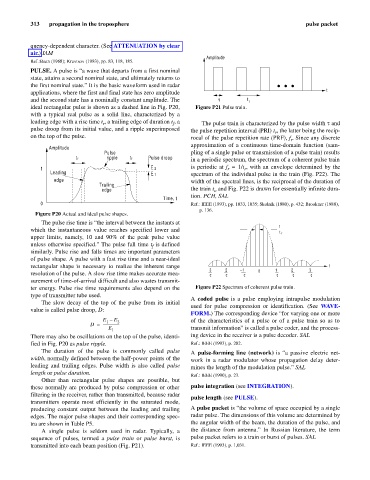
           ideal rectangular pulse is shown as a dashed line in Fig. P20,  Figure P21 Pulse train.
           with a typical real pulse  as  a solid  line, characterized  by  a
           leading edge with a rise time t , a trailing edge of duration t , a  The pulse train is characterized by the pulse width t and
                                                          f
                                   r
           pulse droop from its initial value, and a ripple superimposed  the pulse repetition interval (PRI) t , the latter being the recip-
                                                                                            r
           on the top of the pulse.                             rocal of the pulse repetition rate (PRF), f . Since any discrete
                                                                                                 r
                                                                approximation of a continuous time-domain function (sam-
                 Amplitude
                                    Pulse                       pling of a single pulse or transmission of a pulse train) results
                          tr        ripple  t f   Pulse droop   in a periodic spectrum, the spectrum of a coherent pulse train
              1                                    E 2          is periodic at f  = 1/t , with an envelope determined by the
                                                                            r
                                                                                  r
                  Leading                          E 1          spectrum of the individual pulse in the train (Fig. P22). The
                   edge                                         width of the spectral lines, is the reciprocal of the duration of
                                  Trailing
                                   edge                         the train t  and Fig. P22 is drawn for essentially infinite dura-
                                                                        o
                                                                tion. PCH, SAL
                                                       Time, t
              0                                                 Ref.: IEEE (1993), pp. 1033, 1035; Skolnik (1980), p. 432; Brookner (1988),
                                                                   p. 136.
             Figure P20 Actual and ideal pulse shapes.
               The pulse rise time is “the interval between the instants at
                                                                                             1
           which the instantaneous value reaches specified lower and
                                                                                             t r
           upper limits, namely, 10  and 90% of  the peak  pulse  value
           unless otherwise specified.” The pulse fall time t  is defined
                                                   f
           similarly. Pulse rise and falls times are important parameters
           of pulse shape. A pulse with a fast rise time and a near-ideal
           rectangular shape is necessary to realize the inherent range                                       f
                                                                      3    2     1    0     1    2     3
           resolution of the pulse. A slow rise time makes accurate mea-
                                                                      t     t     t         t     t     t
           surement of time-of-arrival difficult and also wastes transmit-
           ter energy. Pulse rise time requirements also depend on the  Figure P22 Spectrum of coherent pulse train.
           type of transmitter tube used.
                                                                A coded pulse is a pulse employing intrapulse modulation
               The slow decay  of the  top of  the pulse  from its initial
                                                                used  for  pulse compression or identification.  (See  WAVE-
           value is called pulse droop, D:
                                                                FORM.) The corresponding device “for varying one or more
                                   E –  E 2                     of the characteristics of a pulse or of a pulse train so as to
                                    1
                               D =  ------------------
                                     E                          transmit information” is called a pulse coder, and the process-
                                      1
           There may also be oscillations on the top of the pulse, identi-  ing device in the receiver is a pulse decoder. SAL
           fied in Fig. P20 as pulse ripple.                    Ref.: IEEE (1993), p. 202.
               The  duration of  the pulse is commonly called  pulse  A pulse-forming line (network) is “a  passive  electric net-
           width, normally defined between the half-power points of the  work in a radar modulator whose propagation delay deter-
           leading and trailing edges. Pulse width is also called  pulse  mines the length of the modulation pulse.” SAL
           length or pulse duration.
                                                                Ref.: IEEE (1990), p. 23.
               Other than rectangular pulse  shapes are possible, but
           these normally are produced by pulse compression or other  pulse integration (see INTEGRATION).
           filtering in the receiver, rather than transmitted, because radar
                                                                pulse length (see PULSE).
           transmitters  operate most  efficiently in the saturated mode,
           producing constant output  between  the leading  and trailing  A pulse packet is “the volume of space occupied by a single
           edges. The major pulse shapes and their corresponding spec-  radar pulse. The dimensions of this volume are determined by
           tra are shown in Table P5.                           the angular width of the beam, the duration of the pulse, and
               A single pulse is  seldom used in radar. Typically,  a  the distance from antenna.” In Russian literature, the  term
           sequence  of pulses, termed  a pulse  train or  pulse burst, is  pulse packet refers to a train or burst of pulses. SAL
           transmitted into each beam position (Fig. P21).      Ref.: IEEE (1993), p. 1,031.

