


Page 322 - Radar Technology Encyclopedia
P. 322
propagation over the earth                                            propagation in the troposphere  312


                                                                question.” The factor  denotes a  one-way voltage ratio, and
                                Interference region                                             4
                                                      h '       hence appears in the radar equation as F , with range in direct
                                          Intermediate region  t
                                                                proportion:
                                                                                     R = R F
                                                                                          0
              h  r                                        h  t  where  R  is the  free-space range. (See  CHART, Blake;
                                        Diffraction region             0
                                                                RANGE EQUATION.) The usual notation is F, sometimes
                                                                modified to F or F  to distinguish the transmit path from the
                                                                           t
                                                                                r
                                                                              4
                                                                                    2
                                                                                       2
                                                                receive path (F  = F F ). Atmospheric  attenuation  is
                                                                                      r
                                                                                    t
                                                                excluded from F and appears as a separate loss in the range
             Figure P19 Three regions for propagation over the Earth.  equation.
                                                                    It is sometimes convenient to separate the effects of the
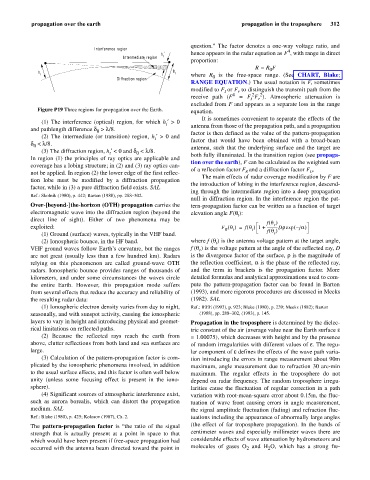
               (1) The interference (optical) region, for which  h ¢ > 0
                                                        t       antenna from those of the propagation path, and a propagation
           and pathlength difference d  > l/8.
                                 0                              factor is then defined as the value of the pattern-propagation
               (2)  The intermediate (or transition) region,  h ¢ > 0 and
                                                    t           factor  that  would have been  obtained with a  broad-beam
           d < l/8.
            0                                                   antenna, such that the underlying surface and the target are
               (3) The diffraction region, h ¢ < 0 and d  < l/8.
                                     t        0                 both fully illuminated. In the transition region (see propaga-
           In region (1) the principles of ray optics are applicable and
                                                                tion over the earth), F can be calculated as the weighted sum
           coverage has a lobing structure; in (2) and (3) ray optics can-
                                                                of a reflection factor F  and a diffraction factor F .
           not be applied. In region (2) the lower edge of the first reflec-      R                    D
                                                                    The main effects of radar coverage modification by F are
           tion lobe must be  modified by a diffraction propagation
                                                                the introduction of lobing in the interference region, descend-
           factor, while in (3) a pure diffraction field exists. SAL
                                                                ing through the intermediate region into a deep propagation
           Ref.: Skolnik (1980), p. 442; Barton (1988), pp. 288–302.
                                                                null in diffraction region. In the interference region the pat-
           Over-[beyond-]the-horizon (OTH) propagation carries the  tern-propagation factor can be written as a function of target
           electromagnetic wave into the diffraction region (beyond the  elevation angle F(q):
                                                                                t
           direct  line of sight). Either of two phenomena  may  be
                                                                                          (
                                                                                         f q )
                                                                                           r
           exploited:                                                     F q() f q() 1 +=  ------------Drexp – (  ja )
                                                                           R  t     t    f q
                                                                                          ()
               (1) Ground (surface) waves, typically in the VHF band.                       t
               (2) Ionospheric bounce, in the HF band.          where f (q) is the antenna voltage pattern at the target angle,
                                                                        t
           VHF ground waves follow Earth’s curvature, but the ranges  f (q) is the voltage pattern at the angle of the reflected ray, D
                                                                   r
           are not great (usually less than a few hundred km). Radars  is the divergence factor of the surface, r is the magnitude of
           relying on  this phenomenon  are called ground-wave  OTH  the reflection coefficient, a is the phase of the reflected ray,
           radars. Ionospheric bounce provides ranges of thousands of  and the term in brackets is the propagation factor. More
           kilometers, and under some  circumstances the waves  circle  detailed formulas and analytical approximations used to com-
           the entire Earth. However, this propagation mode suffers  pute the  pattern-propagation  factor can be found  in Barton
           from several effects that reduce the accuracy and reliability of  (1993), and more rigorous procedures are discussed in Meeks
           the resulting radar data:                            (1982). SAL
               (1) Ionospheric electron density varies from day to night,  Ref.: IEEE (1993), p. 923; Blake (1980), p. 239; Meeks (1982); Barton
           seasonally, and with sunspot activity, causing the ionospheric  (1988), pp. 288–302, (1993), p. 145.
           layers to vary in height and introducing physical and geomet-  Propagation in the troposphere is determined by the dielec-
           rical limitations on reflected paths.                tric constant of the air (average value near the Earth surface e
               (2) Because the reflected rays  reach the  earth  from  = 1.00075), which decreases with height and by the presence
           above, clutter reflections from both land and sea surfaces are  of random irregularities with different values of e The regu-
                                                                                                        .
           large.                                               lar component of e efines the effects of the wave path varia-
                                                                                d
               (3) Calculation of the pattern-propagation factor is com-  tion introducing the errors in range measurement about 90m
           plicated by the ionospheric phenomena involved, in addition  maximum, angle measurement due to refraction 30 arc-min
           to the usual surface effects, and this factor is often well below  maximum.  The regular effects in the  troposphere  do not
           unity (unless some focusing effect is present in the iono-  depend on radar frequency. The random troposphere irregu-
           sphere).                                             larities cause  the fluctuation  of regular  correction  in a path
               (4) Significant sources of atmospheric interference exist,  variation with root-mean-square error about 0.15m, the fluc-
           such as aurora borealis, which can distort the propagation  tuation of wave front causing errors  in angle measurement,
           medium. SAL                                          the signal amplitude fluctuation (fading) and refraction fluc-
           Ref.: Blake (1980), p. 425; Kolosov (1987), Ch. 2.   tuations including the appearance of abnormally large angles
           The  pattern-propagation factor is “the ratio of the signal  (the effect of far troposphere propagation). In the bands of
           strength that is actually present at a point in space to that  centimeter waves and especially millimeter waves there are
           which would have been present if free-space propagation had  considerable effects of wave attenuation by hydrometeors and
           occurred with the antenna beam directed toward the point in  molecules of gases O  and H O, which has a strong fre-
                                                                                  2
                                                                                          2

