


Page 327 - Radar Technology Encyclopedia
P. 327
317   pulse compression, frequency-modulated [FM]                          pulse compression, phase-coded


           in time on filter frequency is a linearly decreasing function of  use a nonlinear FM waveform, in which the transmitted spec-
           frequency (Fig. P27d). The linear characteristic of delay in  trum is weighted, providing a low-sidelobe response with a
           time provides large delay of low-frequency components at the  matched filter. AIL
           beginning of the pulse  in comparison with high-frequency  Ref.: Cook (1967), Chs. 6, 7; Rihaczek (1969), Ch. 7.
           components at its end.
                                                                Phase-coded pulse compression  uses phase-coded wave-
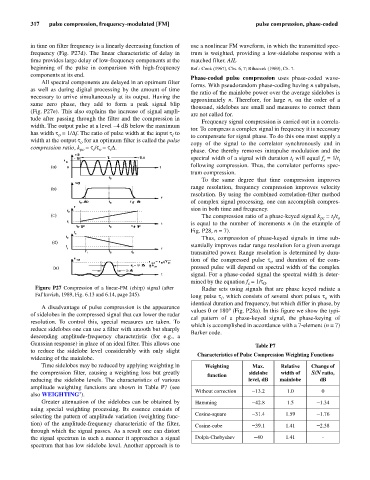
               All spectral components are delayed in an optimum filter
                                                                forms. With pseudorandom phase-coding having n subpulses,
           as well as during digital processing by the amount of time
                                                                the ratio of the mainlobe power over the average sidelobes is
           necessary to arrive simultaneously at its output. Having the
                                                                approximately  n. Therefore, for large  n, on the  order of a
           same zero phase, they add to form  a peak signal  blip
                                                                thousand, sidelobes are small and measures to correct them
           (Fig. P27e). This also explains the increase of signal ampli-
                                                                are not called for.
           tude after passing through the filter and the compression in
                                                                    Frequency signal compression is carried out in a correla-
           width. The output pulse at a level -4 dB below the maximum
                                                                tor. To compress a complex signal in frequency it is necessary
           has width t = 1/Df. The ratio of pulse width at the input t to  to compensate for signal phase. To do this one must supply a
                    o
                                                          i
           width at the output t for an optimum filter is called the pulse  copy of the signal to the correlator synchronously and in
                            o
           compression ratio, k = t/t = tD.                     phase. One  thereby removes  intrapulse modulation and the
                                i o
                                     i
                           pc
                                                                spectral width of a signal with duration t  will equal f = 1/t i
                                                                                                            s
                                                                                                 i
                                                                following compression. Thus, the correlator performs spec-
                                                                trum compression.
                                                                    To  the same degree  that time compression improves
                                                                range resolution,  frequency compression improves  velocity
                                                                resolution. By using the combined correlation-filter method
                                                                of complex signal processing, one can accomplish compres-
                                                                sion in both time and frequency.
                                                                    The compression ratio of a phase-keyed signal k pc  = t /t
                                                                                                               i o
                                                                is equal to the number of increments  n  (in the example of
                                                                Fig. P28, n = 7).
                                                                    Thus, compression of phase-keyed signals in time sub-
                                                                stantially improves radar range resolution for a given average
                                                                transmitted power. Range resolution is determined by dura-
                                                                tion  of the  compressed pulse  t and duration of the  com-
                                                                                          o
                                                                pressed pulse will depend on spectral width of the complex
                                                                signal. For a phase-coded signal the spectral width is deter-
                                                                mined by the equation f = 1/t.
                                                                                   s
                                                                                        0
             Figure P27  Compression of a linear-FM (chirp) signal (after  Radar sets  using signals that are phase keyed radiate a
             Fal’kovich, 1989, Fig. 6.13 and 6.14, page 245).   long pulse t, which consists of several short pulses t with
                                                                                                            o
                                                                          i
                                                                identical duration and frequency, but which differ in phase, by
               A disadvantage of pulse compression is the appearance

                                                                values 0 or 180°(Fig. P28a). In this figure we show the typi-
           of sidelobes in the compressed signal that can lower the radar
                                                                cal pattern of a phase-keyed signal, the phase-keying of
           resolution. To control  this, special measures are taken. To
                                                                which is accomplished in accordance with a 7-element (n = 7)
           reduce sidelobes one can use a filter with smooth but sharply
                                                                Barker code.
           descending amplitude-frequency characteristic (for e.g., a
           Gaussian response) in place of an ideal filter. This allows one           Table P7
           to reduce the sidelobe level considerably with only slight
                                                                  Characteristics of Pulse Compression Weighting Functions
           widening of the mainlobe.
               Time sidelobes may be reduced by applying weighting in  Weighting    Max.      Relative   Change of
           the compression  filter,  causing a weighting loss but  greatly         sidelobe   width of   S/N ratio,
                                                                      function
           reducing the sidelobe  levels. The  characteristics of various          level, dB  mainlobe     dB
           amplitude weighting functions are shown in Table P7 (see
                                                                 Without correction  - 13.2     1.0        0
           also WEIGHTING’).
               Greater attenuation of the sidelobes can be obtained by  Hamming     - 42.8      1.5       - 1.34
           using special weighting  processing. Its essence consists of
           selecting the pattern of amplitude variation (weighting func-  Cosine-square  - 31.4  1.59     - 1.76
           tion) of the amplitude-frequency characteristic of the filter,  Cosine-cube  - 39.1  1.41      - 2.38
           through which the signal passes. As a result one can distort
           the signal spectrum in such a manner it approaches a signal  Dolph-Chebyshev  - 40  1.41        -
           spectrum that has low sidelobe level. Another approach is to

