


Page 326 - Radar Technology Encyclopedia
P. 326
pulse compression, analog                               pulse compression, frequency-modulated [FM]  316


                                Table P6
                  Characteristics of Passive Linear-FM Devices


            (from Skolnik, 1990, Table 10.2, p. 10.13, reprinted by permission of McGraw-Hill)

               The main disadvantages of analog pulse compression are
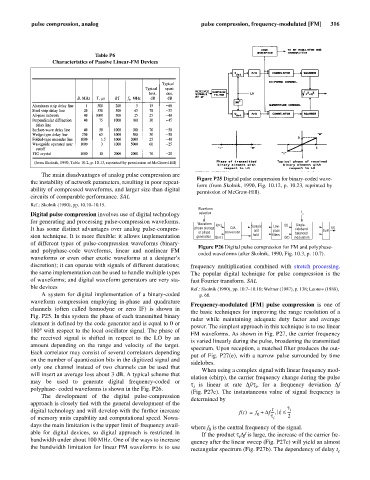
                                                                  Figure P25 Digital pulse compression for binary-coded wave-
           the instability of network parameters, resulting in poor repeat-
                                                                  form (from Skolnik, 1990, Fig. 10.12, p. 10.23, reprinted by
           ability of compressed waveforms, and larger size than digital
                                                                  permission of McGraw-Hill).
           circuits of comparable performance. SAL
           Ref.: Skolnik (1990), pp. 10.10–10.15.
                                                                  Waveform
           Digital pulse compression involves use of digital technology   selection                 f  c
           for generating and processing pulse-compression waveforms.     Waveform  I(n  )     I(t)    Single-
                                                                         t
           It has some distinct advantages over analog pulse-compres-  phase storage        D/A  Sample   Low-   sideband  Sum  f(t)
                                                                                       and
                                                                                            pass
                                                                     or phase  conversion          balanced
           sion technique. It is more flexible: it allows implementation    generation  Q(n  ) t    hold  filters  Q(t)  modulators
           of different types of pulse-compression waveforms (binary-
                                                                   Figure P26 Digital pulse compression for FM and polyphase-
           and polyphase-code waveforms, linear and nonlinear FM
                                                                   coded waveforms (after Skolnik, 1990, Fig. 10.3, p. 10.7).
           waveforms or even other  exotic  waveforms at a designer’s
           discretion); it can operate with signals of different durations;  frequency multiplication combined  with  stretch processing.
           the same implementation can be used to handle multiple types  The popular digital technique  for pulse  compression  is the
           of waveforms; and digital waveform generators are very sta-  fast Fourier transform. SAL
           ble devices                                          Ref.: Skolnik (1990), pp. 10.7–10.10; Wehner (1987), p. 138; Leonov (1988),
               A system for digital implementation of a binary-coded  p. 68.
           waveform compression employing in-phase and quadrature
                                                                Frequency-modulated [FM] pulse compression is  one of
           channels  (often called homodyne or zero IF) is shown in
                                                                the basic techniques for improving the range resolution of a
           Fig. P25. In this system the phase of each transmitted binary
                                                                radar while maintaining adequate duty  factor and average
           element is defined by the code generator and is equal to 0 or
                                                                power. The simplest approach in this technique is to use linear
           180° with respect to the local oscillator signal. The phase of
                                                                FM waveforms. As shown in Fig. P27, the carrier frequency
           the  received signal is shifted in  respect to the  LO by  an
                                                                is varied linearly during the pulse, broadening the transmitted
           amount  depending on the range and velocity of the target.
                                                                spectrum. Upon reception, a matched filter produces the out-
           Each correlator may consist of several correlators depending
                                                                put of Fig. P27(e), with a narrow pulse surrounded by time
           on the number of quantization bits in the digitized signal and
                                                                sidelobes.
           only one channel instead of two channels can be used that
                                                                    When using a complex signal with linear frequency mod-
           will insert an average loss about 3 dB. A typical scheme that
                                                                ulation (chirp), the carrier frequency change during the pulse
           may  be used to generate digital frequency-coded  or
                                                                t is linear at  rate  Df/t, for a  frequency  deviation  Df
                                                                 i
                                                                                     i
           polyphase- coded waveforms is shown in the Fig. P26.
                                                                (Fig. P27c). The instantaneous value of signal frequency is
               The development  of the  digital  pulse-compression
                                                                determined by
           approach is closely tied with the general development of the                         t
                                                                                           t
           digital technology and will develop with the further increase        ft () f +=  0  Df ---- t £ ---- i
                                                                                            ,
           of memory units capability and computational speed. Nowa-                      t i   2
           days the main limitation is the upper limit of frequency avail-  where f  is the central frequency of the signal.
                                                                      0
           able  for  digital devices, so digital approach is  restricted  in  If the product tDf is large, the increase of the carrier fre-
                                                                                i
           bandwidth under about 100 MHz. One of the ways to increase  quency after the linear sweep (Fig. P27c) will yield an almost
           the bandwidth limitation for linear FM waveforms is to use  rectangular spectrum (Fig. P27b). The dependency of delay t e

