


Page 328 - Radar Technology Encyclopedia
P. 328
pulse compression, phase-coded                                pulse repetition frequency, high (HPRF)  318


                                                                ent PRFs are required to eliminate range ambiguity. Eclipsing
                                                                losses are appreciable, and sensitivity time control cannot be
                                                                used, resulting in requirements for the receiver to handle a
                                                                wide range of amplitudes. The advantages are that doppler
                                                                measurement is unambiguous (so blind speeds do not occur
                                                                from ambiguous target doppler within the main-beam clutter
                                                                notch), and long transmitter pulses are not required to obtain
                                                                high average power. The MPRF to large extent is a compro-
                                                                mise mode between LPRF and HPRF, so it tends to share both
                                                                advantages and disadvantages of these modes.
                                                                    Since the requirements  to the proper choice of  optimal
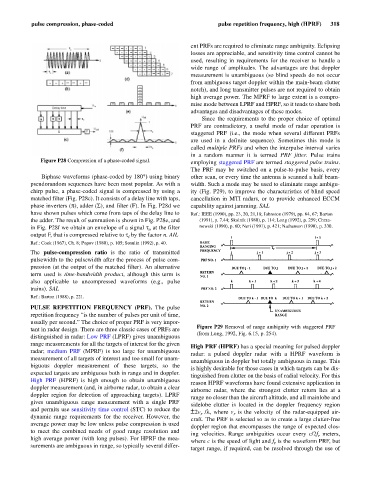
                                                                PRF  are  contradictory,  a useful mode of radar  operation is
                                                                staggered  PRF  (i.e., the  mode when several  different  PRFs
                                                                are used in a definite sequence). Sometimes this mode is
                                                                called multiple PRFs and when the interpulse interval varies
                                                                in a random manner it is termed  PRF jitter. Pulse trains
              Figure P28 Compression of a phase-coded signal.   employing staggered PRF are termed staggered pulse trains.
                                                                The PRF may be  switched on a pulse-to-pulse basis, every
               Biphase waveforms (phase-coded by 180°) using binary  other scan, or every time the antenna is scanned a half beam-
           pseudorandom sequences have been most popular. As with a  width. Such a mode may be used to eliminate range ambigu-
           chirp pulse, a phase-coded signal is compressed by using a  ity (Fig. P29), to improve the characteristics of blind speed
           matched filter (Fig. P28c). It consists of a delay line with taps,  cancellation in MTI radars, or to provide enhanced ECCM
           phase inverters (p), adder (S), and filter (F). In Fig. P28d we  capability against jamming. SAL
           have shown pulses which come from taps of the delay line to  Ref.: IEEE (1990), pp. 23, 20, 21,18; Johnston (1979), pp. 64, 67; Barton
           the adder. The result of summation is shown in Fig. P28e, and  (1991), p. 7.44; Skolnik (1980), p. 114; Long (1992), p. 259; Chrza-
           in Fig. P28f we obtain an envelope of a signal t at the filter  nowski (1990), p. 60; Neri (1991), p. 421; Nathanson (1990), p. 330.
                                                  o
           output F, that is compressed relative to t by the factor n. AIL
                                           i
           Ref.: Cook (1967), Ch. 8; Popov (1980), p. 105; Sosulin (1992), p. 40.
           The  pulse-compression ratio  is  the ratio of transmitted
           pulsewidth to the pulsewidth after the process of pulse com-
           pression (at the output of the matched filter). An alternative
           term used is  time-bandwidth product, although this term  is
           also applicable to uncompressed waveforms (e.g.,  pulse
           trains). SAL
           Ref.: Barton (1988), p. 221.
           PULSE REPETITION FREQUENCY (PRF).  The pulse
           repetition frequency “is the number of pulses per unit of time,
           usually per second.” The choice of proper PRF is very impor-
                                                                  Figure P29 Removal of range ambiguity with staggered PRF
           tant in radar design. There are three classic cases of PRFs are
                                                                  (from Long, 1992, Fig. 6.15, p. 254).
           distinguished in radar: Low PRF (LPRF) gives unambiguous
           range measurements for all the targets of interest for the given
                                                                High PRF (HPRF) has a special meaning for pulsed doppler
           radar;  medium PRF (MPRF) is too large for unambiguous
                                                                radar: a pulsed doppler  radar with a HPRF waveform is
           measurement of all targets of interest and too small for unam-
                                                                unambiguous in doppler but totally ambiguous in range. This
           biguous doppler measurement of these  targets, so the
                                                                is highly desirable for those cases in which targets can be dis-
           expected targets are ambiguous both in range and in doppler.
                                                                tinguished from clutter on the basis of radial velocity. For this
           High PRF (HPRF) is high enough to obtain unambiguous
                                                                reason HPRF waveforms have found extensive application in
           doppler measurement (and, in airborne radar, to obtain a clear
                                                                airborne radar, where the strongest clutter return lies at a
           doppler region for detection of approaching targets). LPRF
                                                                range no closer than the aircraft altitude, and all mainlobe and
           gives unambiguous  range measurement  with a  single PRF
                                                                sidelobe clutter is located in the doppler frequency  region
           and permits use sensitivity time control (STC) to reduce the
                                                                ± 2v  /l, where v   is  the  velocity of the radar-equipped air-
                                                                   r
                                                                              r
           dynamic range requirements  for the receiver. However, the
                                                                craft. The PRF is selected so as to create a large clutter-free
           average power may be low unless pulse compression is used
                                                                doppler region that encompasses the range of expected clos-
           to meet  the combined  needs of  good range resolution  and
                                                                ing velocities. Range ambiguities  occur  every  c/2f  meters,
                                                                                                          r
           high average power (with long pulses). For HPRF the mea-
                                                                where c is the speed of light and f  is the waveform PRF, but
                                                                                            r
           surements are ambiguous in range, so typically several differ-
                                                                target range, if required, can be resolved through the use of

