


Page 321 - Radar Technology Encyclopedia
P. 321
311   propagation, ionospheric                                                 propagation over the earth


           duced. When the wavelength is 5 to 10m or less, the iono-  For radar applications, the most important considerations
           sphere serves as a reflecting medium that makes it possible to  are wave propagation in the atmosphere (see propagation in
           implement over-the-horizon  detection  of targets. (See  the troposphere, ionospheric propagation) and propagation
           RADAR, over-the-horizon.) The main effects of the iono-  in a ferrite medium whose  properties are used in different
           sphere  are inversely proportional to the square of the fre-  microwave devices: phase shifters, attenuators, and so forth.
           quency. For a frequency of 300 MHz, the maximum variation  Typically, the propagation medium is characterized by the
           in range is about 300m, and in elevation (due to refraction)  losses it  inserts  in the propagating  wave, that can lie from
           0.5 mrad, that is much less than for propagation in the tropo-  fractions of a decibel to hundreds of decibels (e.g., for inter-
           sphere. The maximum polarization rotation for quasilongitu-  planetary medium in radar astronomy). IAM
           dal propagation (Faraday rotation effect) is about 13 rad (the  Ref.: Nikol’skiy (1969), p. 35.
           variation  in  polarization structure  due to quasitransversal
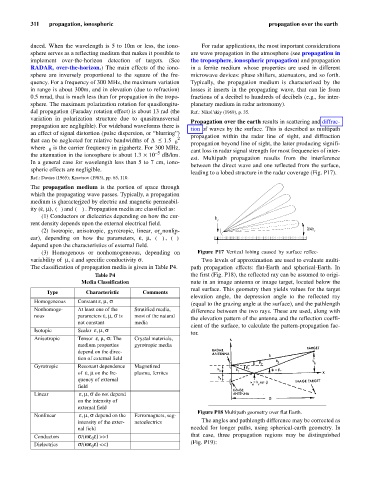
                                                                Propagation over the earth results in scattering and diffrac-
           propagation are negligible). For wideband waveforms there is
                                                                tion of waves by the surface. This is described as multipath
           an effect of signal distortion (pulse dispersion, or “blurring”)  propagation within the radar line of sight, and diffraction
                                                            2
                                                          f
           that can be neglected for relative bandwidths of Df £ 1.5   propagation beyond line of sight, the latter producing signifi-
                                                           0
           where f  is the carrier frequency in gigahertz. For 300 MHz,  cant loss in radar signal strength for most frequencies of inter-
                 0
                                                    - 5
           the attenuation in the ionosphere is about 1.3 ´ 10  dB/km.
                                                                est. Multipath propagation results from the interference
           In a general case for wavelength less than 5 to 7 cm, iono-
                                                                between the direct wave and one reflected from the surface,
           spheric effects are negligible. IAM
                                                                leading to a lobed structure in the radar coverage (Fig. P17).
           Ref.: Davies (1965); Kravtsov (1983), pp. 65, 110.
           The  propagation medium is the portion of space through
           which the propagating wave passes. Typically, a propagation
           medium is characterized by electric and magnetic permeabil-
                      a
                       n ()
           ity (e, m), d  M  . Propagation media are classified as:
                    P
                   ()
               (1) Conductors or dielectrics depending on how the cur-  h
           rent density depends upon the external electrical field.      r
               (2) Isotropic, anisotropic, gyrotropic, linear, or nonlin-                             l /4h  r
                                                             ,
           ear), depending on  how the parameters,  e, m,  ()
                                                    () P
                                                     M
           depend upon the characteristics of external field.
               (3) Homogenous or nonhomogeneous, depending on     Figure P17  Vertical lobing caused  by surface  reflec-
                        ,
           variability of  me and specific conductivity s.          Two levels of approximation are used to evaluate multi-
           The classification of propagation media is given in Table P4.  path  propagation effects: flat-Earth and  spherical-Earth.  In
                                Table P4                        the first (Fig. P18), the reflected ray can be assumed to origi-
                            Media Classification                nate in an image antenna or image target, located below the
                                                                real surface. This geometry then yields values for the target
                Type         Characteristic     Comments
                                                                elevation angle, the  depression angle to the  reflected ray
            Homogeneous    Constant e , m , s
                                                                (equal to the grazing angle at the surface), and the pathlength
            Nonhomoge-     At least one of the   Stratified media,   difference between the two rays. These are used, along with
            nous           parameters e , m , s  is   most of the natural
                                                                the elevation pattern of the antenna and the reflection coeffi-
                           not constant      media
                                                                cient of the surface, to calculate the pattern-propagation fac-
            Isotopic       Scalar  e , m , s
                                                                tor.
            Anisotropic    Tensor  e , m , s : The   Crystal materials,
                           medium properties   gyrotropic media
                           depend on the direc-
                           tion of external field
            Gyrotropic     Resonant dependence   Magnetized
                           of  e , m  on the fre-  plasma, ferrites
                           quency of external
                           field
            Linear          e , m , s  do not depend
                           on the intensity of
                           external field
                                                                  Figure P18 Multipath geometry over flat Earth.
            Nonlinear       e , m , s  depend on the   Ferromagnets, seg-
                           intensity of the exter-  netoelectrics   The angles and pathlength difference may be corrected as
                           nal field                            needed for longer paths, using spherical-earth geometry. In
            Conductors     s /(wee)  >>1                        that case, three propagation  regions may  be  distinguished
                               0
                                                                (Fig. P19):
            Dielectrics    s /(wee)  <<1
                               0

