


Page 334 - Radar Technology Encyclopedia
P. 334
radar, airborne mapping                                                radar, aircraft tail-protection  324


                                                                vate aircraft carry weather-avoidance radar. Commercial air-
                                                                craft  weather-avoidance radars typically operate  at  C-band.
                                                                The  limited space and payload  characteristic make  X-band
                                                                the frequency of choice for most private aircraft and small
                                                                commercial “feeder” airlines. A simple and effective digital
                                                                X-band weather-avoidance radar can weigh less than 50 lb,
                                                                including displays and controls, and require only 4A of 28V
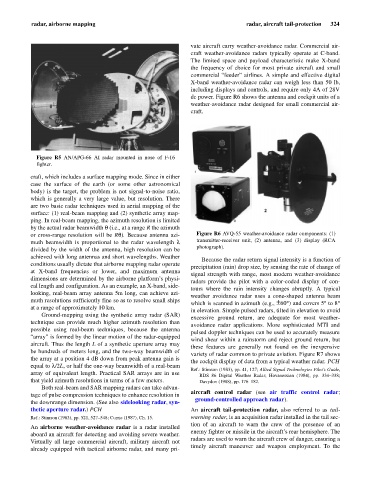
                                                                dc power. Figure R6 shows the antenna and cockpit units of a
                                                                weather-avoidance radar designed for small commercial air-
                                                                craft.


             Figure R5  AN/APG-66  AI radar  mounted in nose of F-16
             fighter.
           craft, which includes a surface mapping mode. Since in either
           case the surface of the  earth (or some other astronomical
           body) is the target, the problem is not signal-to-noise ratio,
           which is generally a very large value, but resolution. There
           are two basic radar techniques used in aerial mapping of the
           surface: (1) real-beam mapping and (2) synthetic array map-
           ping. In real-beam mapping, the azimuth resolution is limited
                                      i.
           by the actual radar beamwidth q (e., at a range R the azimuth
           or cross-range resolution will be  Rq). Because antenna azi-  Figure R6 AVQ-55 weather-avoidance radar components: (1)
           muth beamwidth  is proportional to the  radar  wavelength  l  transmitter-receiver unit, (2) antenna,  and  (3)  display  (RCA
                                                                  photograph).
           divided by the width of the antenna, high resolution can be
           achieved with long antennas and short wavelengths. Weather
                                                                    Because the radar return signal intensity is a function of
           conditions usually dictate that airborne mapping radar operate
                                                                precipitation (rain) drop size, by sensing the rate of change of
           at X-band frequencies or lower, and  maximum antenna
                                                                signal strength with range, most modern weather-avoidance
           dimensions are determined by the airborne platform’s physi-
                                                                radars provide the pilot with a color-coded display of con-
           cal length and configuration. As an example, an X-band, side-
                                                                tours where the rain intensity changes abruptly. A  typical
           looking, real-beam array antenna 5m long, can achieve azi-
                                                                weather avoidance  radar  uses a cone-shaped antenna beam
           muth resolutions sufficiently fine so as to resolve small ships
                                                                which is scanned in azimuth (e.g., ± 60°) and covers 5° to 8°
           at a range of approximately 10 km.
                                                                in elevation. Simple pulsed radars, tilted in elevation to avoid
               Ground-mapping using the synthetic array radar (SAR)
                                                                excessive ground  return, are  adequate for  most weather-
           technique can provide much higher azimuth resolution than
                                                                avoidance radar applications. More sophisticated MTI and
           possible using  real-beam  techniques, because the  antenna
                                                                pulsed doppler techniques can be used to accurately measure
           “array” is formed by the linear motion of the radar-equipped
                                                                wind shear within a rainstorm and reject ground return, but
           aircraft. Thus the length L of a synthetic aperture array may
                                                                these features are generally  not found  on  the inexpensive
           be hundreds of meters long, and the two-way beamwidth of
                                                                variety of radar common to private aviation. Figure R7 shows
           the array at a position 4 dB down from peak antenna gain is
                                                                the cockpit display of data from a typical weather radar. PCH
           equal to l/2L, or half the one-way beamwidth of a real-beam
                                                                Ref.: Stimson (1983), pp. 41, 127; Allied Signal Technologies Pilot’s Guide,
           array of equivalent length. Practical SAR arrays are in use
                                                                   RDS 86 Digital Weather Radar; Hovanessian  (1984),  pp. 334–338;
           that yield azimuth resolutions in terms of a few meters.   Davydov (1988), pp. 176–182.
               Both real-beam and SAR mapping radars can take advan-
                                                                aircraft control radar  (see  air traffic  control radar;
           tage of pulse compression techniques to enhance resolution in
                                                                 ground-controlled approach radar).
           the downrange dimension. (See also sidelooking radar, syn-
           thetic aperture radar.) PCH                          An  aircraft tail-protection radar,  also referred  to as  tail-
           Ref.: Stimson (1983), pp. 521, 527–548; Currie (1987), Ch. 15.  warning radar, is an acquisition radar installed in the tail sec-
                                                                tion of an aircraft to warn the crew of the presence of an
           An airborne weather-avoidance radar is a radar installed
                                                                enemy fighter or missile in the aircraft’s rear hemisphere. The
           aboard an aircraft for detecting and avoiding severe weather.
                                                                radars are used to warn the aircraft crew of danger, ensuring a
           Virtually all large commercial  aircraft,  military aircraft not
                                                                timely aircraft maneuver and weapon  employment. To the
           already equipped with tactical airborne radar, and many pri-

