


Page 175 - Renewable Energy Devices and System with Simulations in MATLAB and ANSYS
P. 175
162 Renewable Energy Devices and Systems with Simulations in MATLAB and ANSYS ®
®
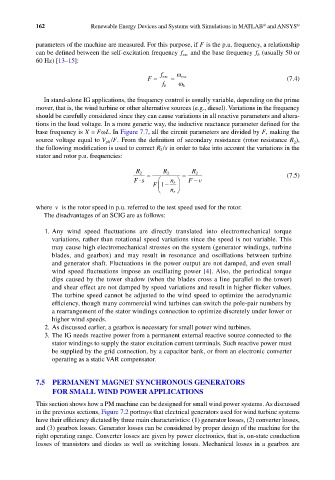
parameters of the machine are measured. For this purpose, if F is the p.u. frequency, a relationship
can be defined between the self-excitation frequency f exc and the base frequency f b (usually 50 or
60 Hz) [13–15]:
ω
F = f exc = exc (7.4)
f b b ω
In stand-alone IG applications, the frequency control is usually variable, depending on the prime
mover, that is, the wind turbine or other alternative sources (e.g., diesel). Variations in the frequency
should be carefully considered since they can cause variations in all reactive parameters and altera-
tions in the load voltage. In a more generic way, the inductive reactance parameter defined for the
base frequency is X =ω
F L. In Figure 7.7, all the circuit parameters are divided by F, making the
source voltage equal to V ph /. From the definition of secondary resistance (rotor resistance R ),
F
2
/
the following modification is used to correct Rs in order to take into account the variations in the
2
stator and rotor p.u. frequencies:
R 2 = R 2 = R 2 (7.5)
Fs ⋅ n r Fv
−
F 1−
n s
where v is the rotor speed in p.u. referred to the test speed used for the rotor.
The disadvantages of an SCIG are as follows:
1. Any wind speed fluctuations are directly translated into electromechanical torque
variations, rather than rotational speed variations since the speed is not variable. This
may cause high electromechanical stresses on the system (generator windings, turbine
blades, and gearbox) and may result in resonance and oscillations between turbine
and generator shaft. Fluctuations in the power output are not damped, and even small
wind speed fluctuations impose an oscillating power [4]. Also, the periodical torque
dips caused by the tower shadow (when the blades cross a line parallel to the tower)
and shear effect are not damped by speed variations and result in higher flicker values.
The turbine speed cannot be adjusted to the wind speed to optimize the aerodynamic
efficiency, though many commercial wind turbines can switch the pole-pair numbers by
a rearrangement of the stator windings connection to optimize discretely under lower or
higher wind speeds.
2. As discussed earlier, a gearbox is necessary for small power wind turbines.
3. The IG needs reactive power from a permanent external reactive source connected to the
stator windings to supply the stator excitation current terminals. Such reactive power must
be supplied by the grid connection, by a capacitor bank, or from an electronic converter
operating as a static VAR compensator.
7.5 PERMANENT MAGNET SYNCHRONOUS GENERATORS
FOR SMALL WIND POWER APPLICATIONS
This section shows how a PM machine can be designed for small wind power systems. As discussed
in the previous sections, Figure 7.2 portrays that electrical generators used for wind turbine systems
have their efficiency dictated by three main characteristics: (1) generator losses, (2) converter losses,
and (3) gearbox losses. Generator losses can be considered by proper design of the machine for the
right operating range. Converter losses are given by power electronics, that is, on-state conduction
losses of transistors and diodes as well as switching losses. Mechanical losses in a gearbox are

