


Page 244 - Robot Builder's Bonanza
P. 244
LOCOMOTION USING WHEELS    213


                                            Steering                                   Steering
                                             wheels                                     wheel


                                             Drive                                     Drive
                                            wheels
                                                                                       wheels

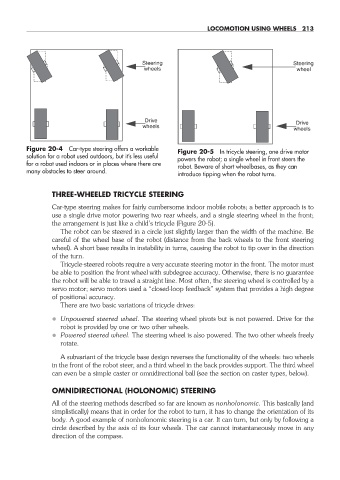
           Figure 20- 4   Car- type steering offers a workable   Figure 20- 5  In tricycle steering, one drive motor
           solution for a robot used outdoors, but it’s less useful   powers the robot; a single wheel in front steers the
           for a robot used indoors or in places where there are   robot. Beware of short wheelbases, as they can
           many obstacles to steer around.            introduce tipping when the robot turns.


                     THREE- WHEELED TRICYCLE STEERING
                     Car- type steering makes for fairly cumbersome indoor mobile robots; a better approach is to
                   use a single drive motor powering two rear wheels, and a single steering wheel in the front;
                   the arrangement is just like a child’s tricycle (Figure 20- 5).
                     The robot can be steered in a circle just slightly larger than the width of the machine. Be
                   careful of the wheel base of the robot (distance from the back wheels to the front steering
                   wheel). A short base results in instability in turns, causing the robot to tip over in the direction
                   of the turn.
                     Tricycle- steered robots require a very accurate steering motor in the front. The motor must
                   be able to position the front wheel with subdegree accuracy. Otherwise, there is no guarantee
                   the robot will be able to travel a straight line. Most often, the steering wheel is controlled by a
                   servo motor; servo motors used a  “closed- loop feedback” system that provides a high degree
                   of positional accuracy.
                     There are two basic variations of tricycle drives:
                   •  Unpowered steered wheel. The steering wheel pivots but is not powered. Drive for the
                     robot is provided by one or two other wheels.
                   •  Powered steered wheel. The steering wheel is also powered. The two other wheels freely
                     rotate.

                     A subvariant of the tricycle base design reverses the functionality of the wheels: two wheels
                   in the front of the robot steer, and a third wheel in the back provides support. The third wheel
                   can even be a simple caster or omnidirectional ball (see the section on caster types, below).

                   OMNIDIRECTIONAL (HOLONOMIC) STEERING
                   All of the steering methods described so far are known as nonholonomic. This basically (and
                   simplistically) means that in order for the robot to turn, it has to change the orientation of its
                   body. A good example of nonholonomic steering is a car. It can turn, but only by following a
                   circle described by the axis of its four wheels. The car cannot instantaneously move in any
                   direction of the compass.


 20-chapter-20.indd   213                                                                   4/21/11   11:50 AM

