


Page 245 - Robot Builder's Bonanza
P. 245
214  MOVING YOUR ROBOT


                     Holonomic drives are distinctive in that they allow motion in any direction, at any time.
                   They can go straight ahead, then suddenly move 90°  sideways— all without changing the
                   orientation of the vehicle. A ball demonstrates holonomic movement: it can instantaneously
                   travel straight, then move in any direction of the compass.
                     The common trait of holonomic steering systems is that the robot is omnidirectional, able
                   to move in both the x and y directions with complete freedom. The most common form of
                   holonomic robot base uses three motors and wheels, arranged in a triangle.

                   How Omnidirectional Steering Is Achieved
                   How exactly does this work? In the majority of robots that use holonomic steering, the secret
                   is in the wheels. There are three wheels, each  driven by a separate motor. Each wheel has
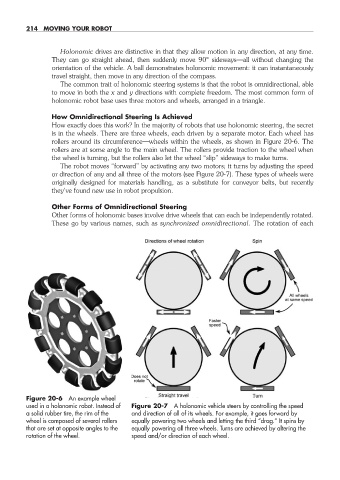
                   rollers around its  circumference— wheels within the wheels, as shown in Figure 20- 6. The
                   rollers are at some angle to the main wheel. The rollers provide traction to the wheel when
                   the wheel is turning, but the rollers also let the wheel “slip” sideways to make turns.
                     The robot moves “forward” by activating any two motors; it turns by adjusting the speed
                   or direction of any and all three of the motors (see Figure 20- 7). These types of wheels were
                   originally designed for materials handling, as a substitute for conveyor belts, but recently
                   they’ve found new use in robot propulsion.

                   Other Forms of Omnidirectional Steering
                   Other forms of holonomic bases involve drive wheels that can each be independently rotated.
                   These go by various names, such as synchronized omnidirectional. The rotation of each


           Figure 20- 6  An example wheel
           used in a holonomic robot. Instead of   Figure 20- 7  A holonomic vehicle steers by controlling the speed
           a solid rubber tire, the rim of the   and direction of all of its wheels. For example, it goes forward by
           wheel is composed of several rollers   equally powering two wheels and letting the third “drag.” It spins by
           that are set at opposite angles to the   equally powering all three wheels. Turns are achieved by altering the
           rotation of the wheel.        speed and/or direction of each wheel.


   20-chapter-20.indd   214                                                                     4/21/11   11:50 AM

