


Page 169 - Robot Builders Source Book - Gordon McComb
P. 169
4.5 Damping of Harmful Vibrations                  157

        Here E is Young's modulus; /j and 1 2 are clear from Figure 4.52, and /j and 7 2 are iner-
        tial moments of the cross-sections I and II, respectively.
           The solution of the independent motion of the cam from Equation (4.37) is as
        follows:


        where n = b c/J c.
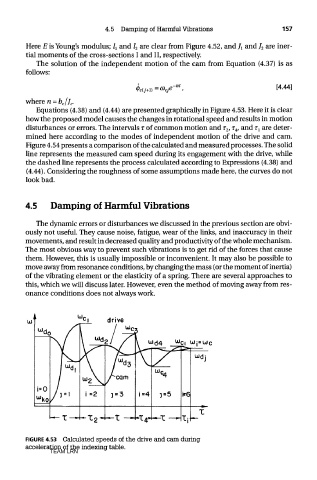
           Equations (4.38) and (4.44) are presented graphically in Figure 4.53. Here it is clear
        how the proposed model causes the changes in rotational speed and results in motion
        disturbances or errors. The intervals r of common motion and T 2, r 4, and T I are deter-
        mined here according to the modes of independent motion of the drive and cam.
        Figure 4.54 presents a comparison of the calculated and measured processes. The solid
        line represents the measured cam speed during its engagement with the drive, while
        the dashed line represents the process calculated according to Expressions (4.38) and
        (4.44). Considering the roughness of some assumptions made here, the curves do not
        look bad.


        4.5    Damping of Harmful Vibrations


           The dynamic errors or disturbances we discussed in the previous section are obvi-
        ously not useful. They cause noise, fatigue, wear of the links, and inaccuracy in their
        movements, and result in decreased quality and productivity of the whole mechanism.
        The most obvious way to prevent such vibrations is to get rid of the forces that cause
        them. However, this is usually impossible or inconvenient. It may also be possible to
        move away from resonance conditions, by changing the mass (or the moment of inertia)
        of the vibrating element or the elasticity of a spring. There are several approaches to
        this, which we will discuss later. However, even the method of moving away from res-
        onance conditions does not always work.


        FIGURE 4.53 Calculated speeds of the drive and cam during
        acceleration of the indexing table.
               TEAM LRN

