


Page 171 - Robot Builders Source Book - Gordon McComb
P. 171
4.5 Damping of Harmful Vibrations                  159


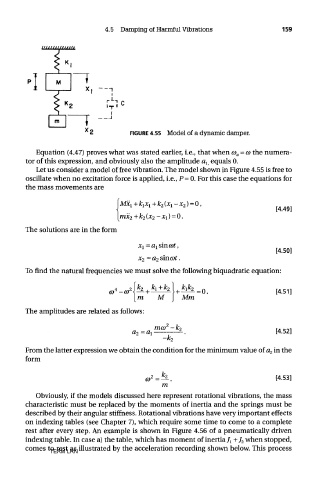
                                      FIGURE 4.55 Model of a dynamic damper.


           Equation (4.47) proves what was stated earlier, i.e., that when co a = (o the numera-
        tor of this expression, and obviously also the amplitude a lt equals 0.
           Let us consider a model of free vibration. The model shown in Figure 4.55 is free to
        oscillate when no excitation force is applied, i.e., P = 0. For this case the equations for
        the mass movements are


        The solutions are in the form


        To find the natural frequencies we must solve the following biquadratic equation:


        The amplitudes are related as follows:


        From the latter expression we obtain the condition for the minimum value of 02 in the
        form


           Obviously, if the models discussed here represent rotational vibrations, the mass
        characteristic must be replaced by the moments of inertia and the springs must be
        described by their angular stiffness. Rotational vibrations have very important effects
        on indexing tables (see Chapter 7), which require some time to come to a complete
        rest after every step. An example is shown in Figure 4.56 of a pneumatically driven
        indexing table. In case a) the table, which has moment of inertia/! +J 2 when stopped,
        comes to rest as illustrated by the acceleration recording shown below. This process
               TEAM LRN

