


Page 173 - Robot Builders Source Book - Gordon McComb
P. 173
4.5 Damping of Harmful Vibrations                  161

        conclusion that there must be some value of c at which a maximum amount of energy
        is absorbed during the relative movement of the vibrating masses, and at which the
        vibrational amplitude of mass Mis thus minimized. Denoting a> a/Q.=f, it can be proved
        that the minimum vibrational amplitude of the main mass M is reached when


        For this condition the vibrational amplitude flj of the main mass M can be estimated
        from the expression


           The last specific case applied to the model shown in Figure 4.55 that we will consider
        here describes the situation where c * 0, and k 2 = 0; that is, when masses M and m are
        connected only by means of the absorber. Such an absorber is called a Lanchester
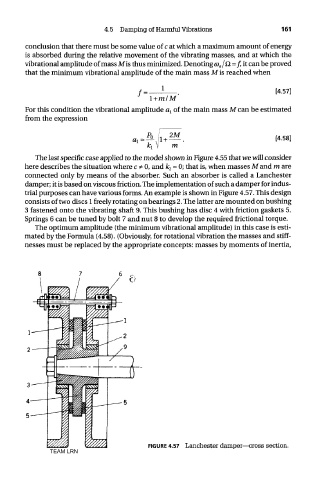
        damper; it is based on viscous friction. The implementation of such a damper for indus-
        trial purposes can have various forms. An example is shown in Figure 4.57. This design
        consists of two discs 1 freely rotating on bearings 2. The latter are mounted on bushing
        3 fastened onto the vibrating shaft 9. This bushing has disc 4 with friction gaskets 5.
        Springs 6 can be tuned by bolt 7 and nut 8 to develop the required factional torque.
           The optimum amplitude (the minimum vibrational amplitude) in this case is esti-
        mated by the Formula (4.58). (Obviously, for rotational vibration the masses and stiff-
        nesses must be replaced by the appropriate concepts: masses by moments of inertia,


                                            FIGURE 4.57 Lanchester damper—cross section.
               TEAM LRN

