


Page 178 - Robot Builders Source Book - Gordon McComb
P. 178
166               Kinematics and Control of Automatic Machines


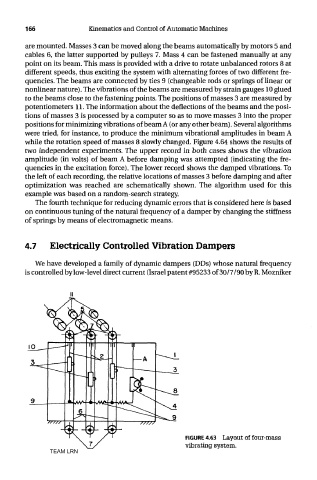
         are mounted. Masses 3 can be moved along the beams automatically by motors 5 and
         cables 6, the latter supported by pulleys 7. Mass 4 can be fastened manually at any
         point on its beam. This mass is provided with a drive to rotate unbalanced rotors 8 at
         different speeds, thus exciting the system with alternating forces of two different fre-
         quencies. The beams are connected by ties 9 (changeable rods or springs of linear or
         nonlinear nature). The vibrations of the beams are measured by strain gauges 10 glued
         to the beams close to the fastening points. The positions of masses 3 are measured by
         potentiometers 11. The information about the deflections of the beams and the posi-
         tions of masses 3 is processed by a computer so as to move masses 3 into the proper
         positions for minimizing vibrations of beam A (or any other beam). Several algorithms
         were tried, for instance, to produce the minimum vibrational amplitudes in beam A
         while the rotation speed of masses 8 slowly changed. Figure 4.64 shows the results of
         two independent experiments. The upper record in both cases shows the vibration
         amplitude (in volts) of beam A before damping was attempted (indicating the fre-
         quencies in the excitation force). The lower record shows the damped vibrations. To
         the left of each recording, the relative locations of masses 3 before damping and after
         optimization was reached are schematically shown. The algorithm used for this
         example was based on a random-search strategy.
            The fourth technique for reducing dynamic errors that is considered here is based
         on continuous tuning of the natural frequency of a damper by changing the stiffness
         of springs by means of electromagnetic means.


         4.7    Electrically Controlled Vibration Dampers


            We have developed a family of dynamic dampers (DDs) whose natural frequency
         is controlled by low-level direct current (Israel patent #95233 of 30/7/90 by R. Mozniker


                                                       FIGURE 4.63 Layout of four-mass
                                                       vibrating system.
               TEAM LRN

