


Page 179 - Robot Builders Source Book - Gordon McComb
P. 179
4.7 Electrically Controlled Vibration Dampers          167

        & B-Z. Sandier). These DDs are suitable for damping vibrations with frequencies of
        about 15-100 Hz or more.
           As a first case, we consider the DD layout presented in Figure 4.55. Here, two masses
        M and m connected by means of springs kj and k 2 and energy absorber c (in this case,
        friction sources are proportional to the relative speed of the vibrating bodies) are shown.
        A force P acts on the mass M. Figure 4.65 illustrates the "amplitude-frequency" char-
        acteristic of such a device for ideal conditions, i.e., zero friction.
           It is clearly seen here that at about k 2/m = 14 the amplitudes of oscillations al = 0.
           Figure 4.66 shows that this damping occurs in a very narrow band of the ratio k 2 /m
         (in this example, k 2/m ~ 20). To reach such a control level in real time is possible, if at
        all, only by electronic means.
           The DD designed in accordance with the patent mentioned above is shown in Figure
        4.67 and consists of a base 1, a spring system 2, a mass 3, a magnet core 4, and a coil 5.
           By changing the voltage (about 15-20 millivolts) in the coil 5, we control the restor-
        ing force developed by the flat springs 2, or, in other words, the stiffness of the springs,
        and, as a result, the natural frequency of the DD. In Figure 4.68 we show a photograph
        of an experimental device.
           When the frequency is essentially lower, the device becomes too "soft" and less
        practical. Therefore, the concept of active damping (AD) must be introduced. For
        instance, we measured the transient vibrations of a robot's arm in several orthogonal
        directions. The average frequency of vibrations for different arm lengths and masses
        kept in the gripper was about 1.5-3 Hz (10-20 rad/sec). The natural frequency of this
        device is in the neighborhood of 15 rad/sec, which brings us to very low spring stiff-
        ness and makes the device less practical for industrial use.
           The convenience in using this device lies in the fact that no mechanical displace-
        ment of any kind is needed to tune it. Tuning is done by purely electrical means, which
        simplifies the interaction between the damper and other automatization systems—
        such as electronic circuits, microprocessors, or even computers. The disadvantage of
        this damper is that it is essentially nonlinear and therefore when the vibrational ampli-
        tude of the vibrating base changes, the natural frequency of the damper must be
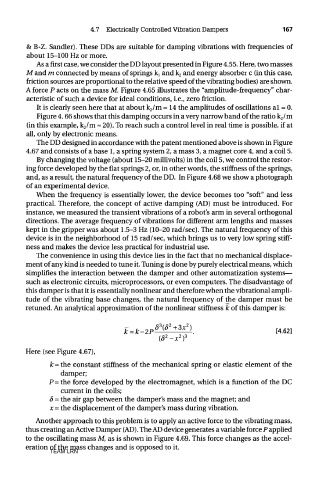
        retuned. An analytical approximation of the nonlinear stiffness k of this damper is:


        Here (see Figure 4.67),
               k = the constant stiffness of the mechanical spring or elastic element of the
                  damper;
               P = the force developed by the electromagnet, which is a function of the DC
                  current in the coils;
               6 = the air gap between the damper's mass and the magnet; and
               x = the displacement of the damper's mass during vibration.
           Another approach to this problem is to apply an active force to the vibrating mass,
        thus creating an Active Damper (AD). The AD device generates a variable force P applied
        to the oscillating mass M, as is shown in Figure 4.69. This force changes as the accel-
        eration of the mass changes and is opposed to it.
               TEAM LRN

