


Page 253 - Robot Builders Source Book - Gordon McComb
P. 253
7.4 Feeding of Oriented Parts from Magazines            241

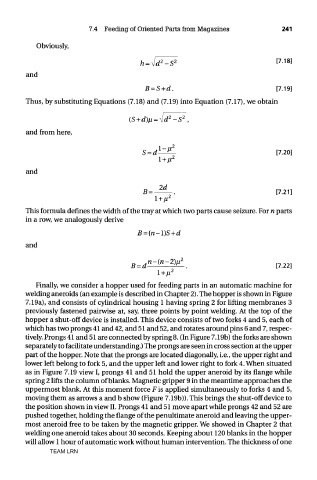
           Obviously,


        and


        Thus, by substituting Equations (7.18) and (7.19) into Equation (7.17), we obtain


        and from here,


        and


        This formula defines the width of the tray at which two parts cause seizure. For n parts
        in a row, we analogously derive


        and


           Finally, we consider a hopper used for feeding parts in an automatic machine for
        welding aneroids (an example is described in Chapter 2). The hopper is shown in Figure
        7.19a), and consists of cylindrical housing 1 having spring 2 for lifting membranes 3
        previously fastened pairwise at, say, three points by point welding. At the top of the
        hopper a shut-off device is installed. This device consists of two forks 4 and 5, each of
        which has two prongs 41 and 42, and 51 and 52, and rotates around pins 6 and 7, respec-
        tively. Prongs 41 and 51 are connected by spring 8. (In Figure 7.19b) the forks are shown
        separately to facilitate understanding.) The prongs are seen in cross section at the upper
        part of the hopper. Note that the prongs are located diagonally, i.e., the upper right and
        lower left belong to fork 5, and the upper left and lower right to fork 4. When situated
        as in Figure 7.19 view I, prongs 41 and 51 hold the upper aneroid by its flange while
        spring 2 lifts the column of blanks. Magnetic gripper 9 in the meantime approaches the
        uppermost blank. At this moment force F is applied simultaneously to forks 4 and 5,
        moving them as arrows a and b show (Figure 7.19b)). This brings the shut-off device to
        the position shown in view II. Prongs 41 and 51 move apart while prongs 42 and 52 are
        pushed together, holding the flange of the penultimate aneroid and leaving the upper-
        most aneroid free to be taken by the magnetic gripper. We showed in Chapter 2 that
        welding one aneroid takes about 30 seconds. Keeping about 120 blanks in the hopper
        will allow 1 hour of automatic work without human intervention. The thickness of one
               TEAM LRN

