


Page 67 - Robot Builders Source Book - Gordon McComb
P. 67
56                           Concepts and Layouts

           Some words of explanation: what we mean by clarity when it comes to mechani-
        cal systems may be demonstrated by the following extreme example. When a mecha-
        nism is rotated slowly, almost everyone is able to understand how it works, its logic;
        and when broken or out of order it is relatively easy to locate the broken or worn part
        simply by looking at it. By contrast, in electronic systems, extensive measurement and
        special knowledge are needed to pinpoint defects in, say, a mounted plate. This is why
        we generally replace the suspect plate by a new one in electronic systems, instead of
        replacing a part or even repairing it as in mechanical systems. A purely mechanical
        system is usually driven at a single point, the input, and no additional energy supply
        is needed along the kinematic chain; in some cases, however, a multidrive system is
        more effective. The layout will then include a multiple of electromotors or hydro-
        cylinders. (Pneumatic and hydraulic systems, for instance, require air or liquid supply
        to every cylinder or valve along the system.)
           We have at our disposal a wide range of known and examined solutions for achiev-
        ing various movements. Moreover, when electric, hydraulic, or pneumatic drives are
        used to effect complex motions, they are generally combined with mechanical devices.
        This is because the latter make it possible to achieve accurate displacement thanks to
        the rigidity of mechanical parts.
           Thanks to the use of high pressure, the transmission of large forces to considerable
        distances in hydraulic systems can be realized in small volumes where a purely mechan-
        ical solution would entail the use of massive parts, massive supports, massive joints,
        etc. The fact that liquid consumption is easily controlled ensures fine control of the
        piston speed, while the nature of liquid flow ensures smoothness of piston displace-
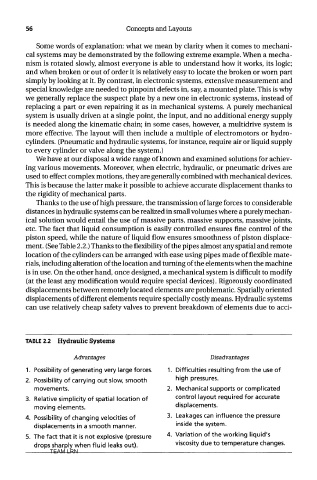
        ment. (See Table 2.2.) Thanks to the flexibility of the pipes almost any spatial and remote
        location of the cylinders can be arranged with ease using pipes made of flexible mate-
        rials, including alteration of the location and turning of the elements when the machine
        is in use. On the other hand, once designed, a mechanical system is difficult to modify
        (at the least any modification would require special devices). Rigorously coordinated
        displacements between remotely located elements are problematic. Spatially oriented
        displacements of different elements require specially costly means. Hydraulic systems
        can use relatively cheap safety valves to prevent breakdown of elements due to acci-


        TABLE 2.2 Hydraulic Systems

                      Advantages                             Disadvantages
        1. Possibility of generating very large forces.  1. Difficulties resulting from the use of
                                                   high pressures.
        2. Possibility of carrying out slow, smooth
           movements.                            2. Mechanical supports or complicated
        3. Relative simplicity of spatial location of  control layout required for accurate
           moving elements.                        displacements.
        4. Possibility of changing velocities of  3. Leakages can influence the pressure
           displacements in a smooth manner.       inside the system.
                                                 4. Variation of the working liquid's
        5. The fact that it is not explosive (pressure
           drops sharply when fluid leaks out).    viscosity due to temperature changes.
               TEAM LRN

