


Page 68 - Robot Builders Source Book - Gordon McComb
P. 68
2.4 The Kinematic Layout                        57

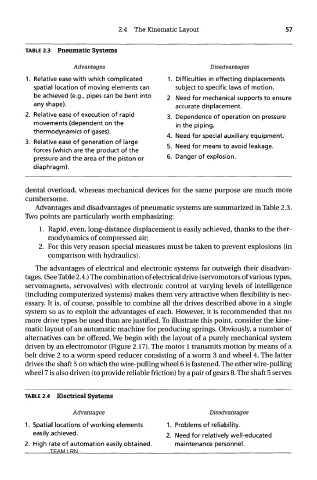
        TABLE 2.3 Pneumatic Systems


                      Advantages                              Disadvan tages
         1. Relative ease with which complicated  1. Difficulties in effecting displacements
           spatial location of moving elements can  subject to specific laws of motion.
           be achieved (e.g., pipes can be bent into  2 Need for mechanical supports to ensure
           any shape).                              accurate displacement.
        2. Relative ease of execution of rapid
                                                 3. Dependence of operation on pressure
           movements (dependent on the              in the piping.
           thermodynamics of gases).
                                                 4. Need for special auxiliary equipment.
        3. Relative ease of generation of large
                                                 5. Need for means to avoid leakage.
           forces (which are the product of the
           pressure and the area of the piston or  6. Danger of explosion.
           diaphragm).


        dental overload, whereas mechanical devices for the same purpose are much more
        cumbersome.
           Advantages and disadvantages of pneumatic systems are summarized in Table 2.3.
        Two points are particularly worth emphasizing:
            1. Rapid, even, long-distance displacement is easily achieved, thanks to the ther-
               modynamics of compressed air;
            2. For this very reason special measures must be taken to prevent explosions (in
               comparison with hydraulics).

           The advantages of electrical and electronic systems far outweigh their disadvan-
        tages. (See Table 2.4.) The combination of electrical drive (servomotors of various types,
        servomagnets, servovalves) with electronic control at varying levels of intelligence
        (including computerized systems) makes them very attractive when flexibility is nec-
        essary. It is, of course, possible to combine all the drives described above in a single
        system so as to exploit the advantages of each. However, it is recommended that no
        more drive types be used than are justified. To illustrate this point, consider the kine-
        matic layout of an automatic machine for producing springs. Obviously, a number of
        alternatives can be offered. We begin with the layout of a purely mechanical system
        driven by an electromotor (Figure 2.17). The motor 1 transmits motion by means of a
        belt drive 2 to a worm speed reducer consisting of a worm 3 and wheel 4. The latter
        drives the shaft 5 on which the wire-pulling wheel 6 is fastened. The other wire-pulling
        wheel 7 is also driven (to provide reliable friction) by a pair of gears 8. The shaft 5 serves


        TABLE 2.4 Electrical Systems


                      Advantages                             Disadvantages
        1. Spatial locations of working elements  1. Problems of reliability.
           easily achieved.                      2. Need for relatively well-educated
        2. High rate of automation easily obtained.  maintenance personnel.
               TEAM LRN

