


Page 189 - Robotics Designing the Mechanisms for Automated Machinery
P. 189
5.1 Linear and Angular Displacement Sensors             177

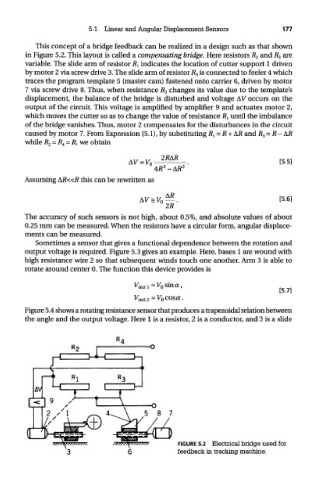
           This concept of a bridge feedback can be realized in a design such as that shown
        in Figure 5.2. This layout is called a compensating bridge. Here resistors R^ and R 3 are
        variable. The slide arm of resistor R l indicates the location of cutter support 1 driven
        by motor 2 via screw drive 3. The slide arm of resistor R 3 is connected to feeler 4 which
        traces the program template 5 (master cam) fastened onto carrier 6, driven by motor
        7 via screw drive 8. Thus, when resistance R 3 changes its value due to the template's
        displacement, the balance of the bridge is disturbed and voltage AV" occurs on the
        output of the circuit. This voltage is amplified by amplifier 9 and actuates motor 2,
        which moves the cutter so as to change the value of resistance R 1 until the imbalance
        of the bridge vanishes. Thus, motor 2 compensates for the disturbances in the circuit
        caused by motor 7. From Expression (5.1), by substituting J? x = R + AR and R 3 = R-AR
        while R 2 = R 4 = R, we obtain


        Assuming AR«R this can be rewritten as


        The accuracy of such sensors is not high, about 0.5%, and absolute values of about
        0.25 mm can be measured. When the resistors have a circular form, angular displace-
        ments can be measured.
           Sometimes a sensor that gives a functional dependence between the rotation and
        output voltage is required. Figure 5.3 gives an example. Here, bases 1 are wound with
        high resistance wire 2 so that subsequent winds touch one another. Arm 3 is able to
        rotate around center 0. The function this device provides is


        Figure 5.4 shows a rotating resistance sensor that produces a trapezoidal relation between
        the angle and the output voltage. Here 1 is a resistor, 2 is a conductor, and 3 is a slide


                                                    FIGURE 5.2 Electrical bridge used for
                                                    feedback in tracking machine.

