


Page 191 - Robotics Designing the Mechanisms for Automated Machinery
P. 191
5.1 Linear and Angular Displacement Sensors            179


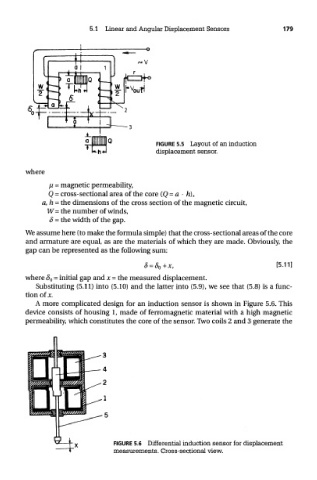
                                              FIGURE 5.5 Layout of an induction
                                              displacement sensor.

        where

               // = magnetic permeability,
               Q = cross-sectional area of the core (Q = a • h),
             a,h = the dimensions of the cross section of the magnetic circuit,
              W= the number of winds,
               8 = the width of the gap.
        We assume here (to make the formula simple) that the cross-sectional areas of the core
        and armature are equal, as are the materials of which they are made. Obviously, the
        gap can be represented as the following sum:


        where § 0 = initial gap and x = the measured displacement.
           Substituting (5.11) into (5.10) and the latter into (5.9), we see that (5.8) is a func-
        tion of jc.
           A more complicated design for an induction sensor is shown in Figure 5.6. This
        device consists of housing 1, made of ferromagnetic material with a high magnetic
        permeability, which constitutes the core of the sensor. Two coils 2 and 3 generate the


                                 FIGURE 5.6 Differential induction sensor for displacement
                                 measurements. Cross-sectional view.

