


Page 134 - Rotating Machinery Pratical Solutions to Unbalance and Misalignment
P. 134
Rotating Machinery: Practical Solutions

            processes. They are discussed in more detail later in this and the
            following chapters.
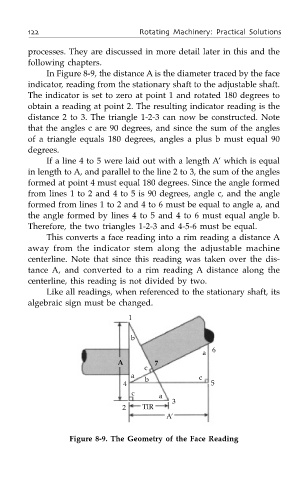
                 In Figure 8-9, the distance A is the diameter traced by the face
            indicator, reading from the stationary shaft to the adjustable shaft.
            The indicator is set to zero at point 1 and rotated 180 degrees to
            obtain a reading at point 2. The resulting indicator reading is the
            distance 2 to 3. The triangle 1-2-3 can now be constructed. Note
            that the angles c are 90 degrees, and since the sum of the angles
            of a triangle equals 180 degrees, angles a plus b must equal 90
            degrees.
                 If a line 4 to 5 were laid out with a length A’ which is equal
            in length to A, and parallel to the line 2 to 3, the sum of the angles
            formed at point 4 must equal 180 degrees. Since the angle formed
            from lines 1 to 2 and 4 to 5 is 90 degrees, angle c, and the angle
            formed from lines 1 to 2 and 4 to 6 must be equal to angle a, and
            the angle formed by lines 4 to 5 and 4 to 6 must equal angle b.
            Therefore, the two triangles 1-2-3 and 4-5-6 must be equal.
                 This converts a face reading into a rim reading a distance A
            away from the indicator stem along the adjustable machine
            centerline. Note that since this reading was taken over the dis-
            tance  A, and converted to a rim reading  A distance along the
            centerline, this reading is not divided by two.
                 Like all readings, when referenced to the stationary shaft, its
            algebraic sign must be changed.
                                      1


                                      b
                                                         a   6
                                   A        7
                                          c
                                      a   b             c
                                    4                      5
                                      c      a
                                                 3
                                    2    TIR
                                               A’


                      Figure 8-9. The Geometry of the Face Reading

