


Page 135 - Rotating Machinery Pratical Solutions to Unbalance and Misalignment
P. 135
Advanced Machine Alignment


                                                        A


                   A/2


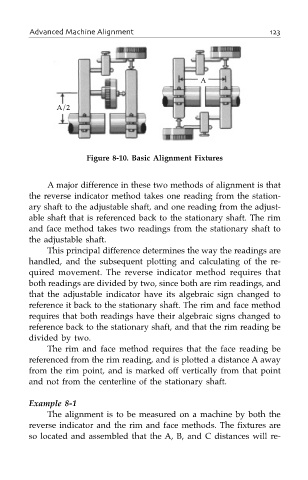
                           Figure 8-10. Basic Alignment Fixtures


                 A major difference in these two methods of alignment is that
            the reverse indicator method takes one reading from the station-
            ary shaft to the adjustable shaft, and one reading from the adjust-
            able shaft that is referenced back to the stationary shaft. The rim
            and face method takes two readings from the stationary shaft to
            the adjustable shaft.
                 This principal difference determines the way the readings are
            handled, and the subsequent plotting and calculating of the re-
            quired movement. The reverse indicator method requires that
            both readings are divided by two, since both are rim readings, and
            that the adjustable indicator have its algebraic sign changed to
            reference it back to the stationary shaft. The rim and face method
            requires that both readings have their algebraic signs changed to
            reference back to the stationary shaft, and that the rim reading be
            divided by two.
                 The rim and face method requires that the face reading be
            referenced from the rim reading, and is plotted a distance A away
            from the rim point, and is marked off vertically from that point
            and not from the centerline of the stationary shaft.

            Example 8-1
                 The alignment is to be measured on a machine by both the
            reverse indicator and the rim and face methods. The fixtures are
            so located and assembled that the A, B, and C distances will re-

