


Page 202 - Sedimentology and Stratigraphy
P. 202
Variations in Delta Morphology and Facies  189


 *!	  	                               $


                                                                                      $


                                                                                           $


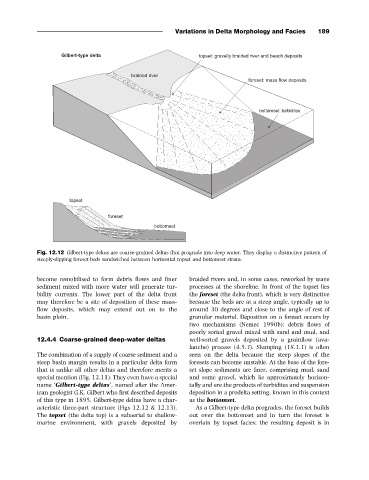
                 Fig. 12.12 Gilbert-type deltas are coarse-grained deltas that prograde into deep water. They display a distinctive pattern of
                 steeply-dipping foreset beds sandwiched between horizontal topset and bottomset strata.


                 become remobilised to form debris flows and finer  braided rivers and, in some cases, reworked by wave
                 sediment mixed with more water will generate tur-  processes at the shoreline. In front of the topset lies
                 bidity currents. The lower part of the delta front  the foreset (the delta front), which is very distinctive
                 may therefore be a site of deposition of these mass-  because the beds are at a steep angle, typically up to
                 flow deposits, which may extend out on to the  around 30 degrees and close to the angle of rest of
                 basin plain.                                 granular material. Deposition on a foreset occurs by
                                                              two mechanisms (Nemec 1990b): debris flows of
                                                              poorly sorted gravel mixed with sand and mud, and
                 12.4.4 Coarse-grained deep-water deltas      well-sorted gravels deposited by a grainflow (ava-
                                                              lanche) process (4.5.3). Slumping (18.1.1) is often
                 The combination of a supply of coarse sediment and a  seen on the delta because the steep slopes of the
                 steep basin margin results in a particular delta form  foresets can become unstable. At the base of the fore-
                 that is unlike all other deltas and therefore merits a  set slope sediments are finer, comprising mud, sand
                 special mention (Fig. 12.11). They even have a special  and some gravel, which lie approximately horizon-
                 name ‘Gilbert-type deltas’, named after the Amer-  tally and are the products of turbidites and suspension
                 ican geologist G.K. Gilbert who first described deposits  deposition in a prodelta setting, known in this context
                 of this type in 1895. Gilbert-type deltas have a char-  as the bottomset.
                 acteristic three-part structure (Figs 12.12 & 12.13).  As a Gilbert-type delta progrades, the foreset builds
                 The topset (the delta top) is a subaerial to shallow-  out over the bottomset and in turn the foreset is
                 marine environment, with gravels deposited by  overlain by topset facies: the resulting deposit is in

