


Page 205 - Sedimentology and Stratigraphy
P. 205
192    Deltas


                                                                       *


                    )
                                                                 (

                                                           &
                                                    %
        +&,
                                                              '
                                                                       +',


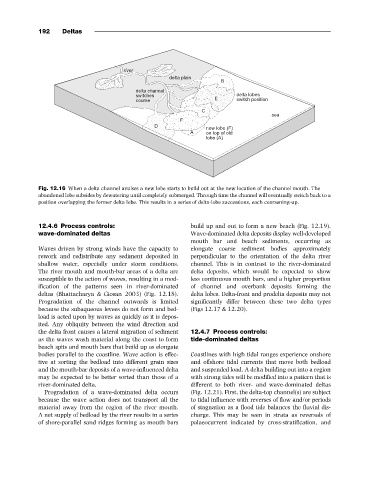
                  Fig. 12.16 When a delta channel avulses a new lobe starts to build out at the new location of the channel mouth. The
                  abandoned lobe subsides by dewatering until completely submerged. Through time the channel will eventually switch back to a
                  position overlapping the former delta lobe. This results in a series of delta-lobe successions, each coarsening-up.


                  12.4.6 Process controls:                    build up and out to form a new beach (Fig. 12.19).
                  wave-dominated deltas                       Wave-dominated delta deposits display well-developed
                                                              mouth bar and beach sediments, occurring as
                  Waves driven by strong winds have the capacity to  elongate coarse sediment bodies approximately
                  rework and redistribute any sediment deposited in  perpendicular to the orientation of the delta river
                  shallow water, especially under storm conditions.  channel. This is in contrast to the river-dominated
                  The river mouth and mouth-bar areas of a delta are  delta deposits, which would be expected to show
                  susceptible to the action of waves, resulting in a mod-  less continuous mouth bars, and a higher proportion
                  ification of the patterns seen in river-dominated  of channel and overbank deposits forming the
                  deltas (Bhattacharya & Giosan 2003) (Fig. 12.18).  delta lobes. Delta-front and prodelta deposits may not
                  Progradation of the channel outwards is limited  significantly differ between these two delta types
                  because the subaqueous levees do not form and bed-  (Figs 12.17 & 12.20).
                  load is acted upon by waves as quickly as it is depos-
                  ited. Any obliquity between the wind direction and
                  the delta front causes a lateral migration of sediment  12.4.7 Process controls:
                  as the waves wash material along the coast to form  tide-dominated deltas
                  beach spits and mouth bars that build up as elongate
                  bodies parallel to the coastline. Wave action is effec-  Coastlines with high tidal ranges experience onshore
                  tive at sorting the bedload into different grain sizes  and offshore tidal currents that move both bedload
                  and the mouth-bar deposits of a wave-influenced delta  and suspended load. A delta building out into a region
                  may be expected to be better sorted than those of a  with strong tides will be modified into a pattern that is
                  river-dominated delta.                      different to both river- and wave-dominated deltas
                    Progradation of a wave-dominated delta occurs  (Fig. 12.21). First, the delta-top channel(s) are subject
                  because the wave action does not transport all the  to tidal influence with reverses of flow and/or periods
                  material away from the region of the river mouth.  of stagnation as a flood tide balances the fluvial dis-
                  A net supply of bedload by the river results in a series  charge. This may be seen in strata as reversals of
                  of shore-parallel sand ridges forming as mouth bars  palaeocurrent indicated by cross-stratification, and

