


Page 210 - Sedimentology and Stratigraphy
P. 210
Recognition of Deltaic Deposits  197


                                                              only rarely associated with deltas, occurring as accu-
                                                              mulations on delta fronts where the supply of clastic
                                                              detritus is low: examples in modern settings and from
                                                              the stratigraphic record indicate that carbonates form
                                                              on deltas in arid and semi-arid environments, where
                                                              the supply of clastic sediment to the delta is highly
                                                              ephemeral (Bosence 2005).
                                                               Palaeontological evidence from fauna and flora
                                                              can be important in the recognition of the marine
                                                              and continental subenvironments of a delta. A dis-
                                                              tinct fauna tolerant of brackish water may be found
                                                              near the mouths of channels and in the interdistri-
                                                              butary bays where fresh and marine water mix. The
                                                              mixture of shallow-marine, brackish and freshwater
                                                              fauna plus coastal vegetation is also characteristic of
                                                              deltaic environments. The contrast between fresh
                                                              and saline water is not present in deltas formed at
                                                              the margins of freshwater lakes and in these settings
                                                              the recognition of the delta must be based on the
                                                              facies patterns.
                                                               A final point to emphasise is that the various
                                                              models of different types of delta presented in this
                                                              chapter are just a few examples of the possible com-
                                                              binations of the controls that determine the form and
                                                              facies of a delta. Any modern or ancient delta should
                                                              be considered in terms of the evidence for the effects
                                                              of different factors – sediment grain size, basin water
                                                              depth, the relative importance of river, tide and wave
                                                              influences – and should not be expected to exactly
                                                              match any of the models presented here or any other
                                                              text books.
                                                              Characteristics of deltaic deposits
                                                              . lithologies – conglomerate, sandstone and mudstone
                                                              . mineralogy – variable, delta-front facies may be
                                                              compositionally mature
                                                              . texture – moderately mature in delta-top sands and
                                                              gravels, mature in wave-reworked delta-front deposits
                                                              . bed geometry – lens-shaped delta channels, mouth-
                                                              bar lenses variably elongate, prodelta deposits thin
                                                              bedded
                                                              . sedimentary structures – cross-bedding and lamina-
                                                              tion in delta-top and mouth-bar facies
                                                              . palaeocurrents – topset facies indicate direction of
                                                              progradation, wave and tidal reworking variable on
                                                              delta front
                                                              . fossils – association of terrestrial plants and animals
                                                              of the delta top with marine fauna of the delta front
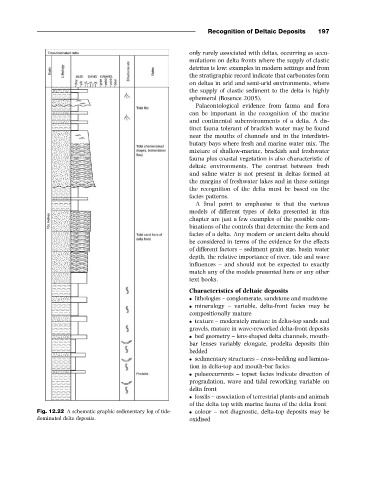
                 Fig. 12.22 A schematic graphic sedimentary log of tide-  . colour – not diagnostic, delta-top deposits may be
                 dominated delta deposits.                    oxidised

